
No products in the cart.

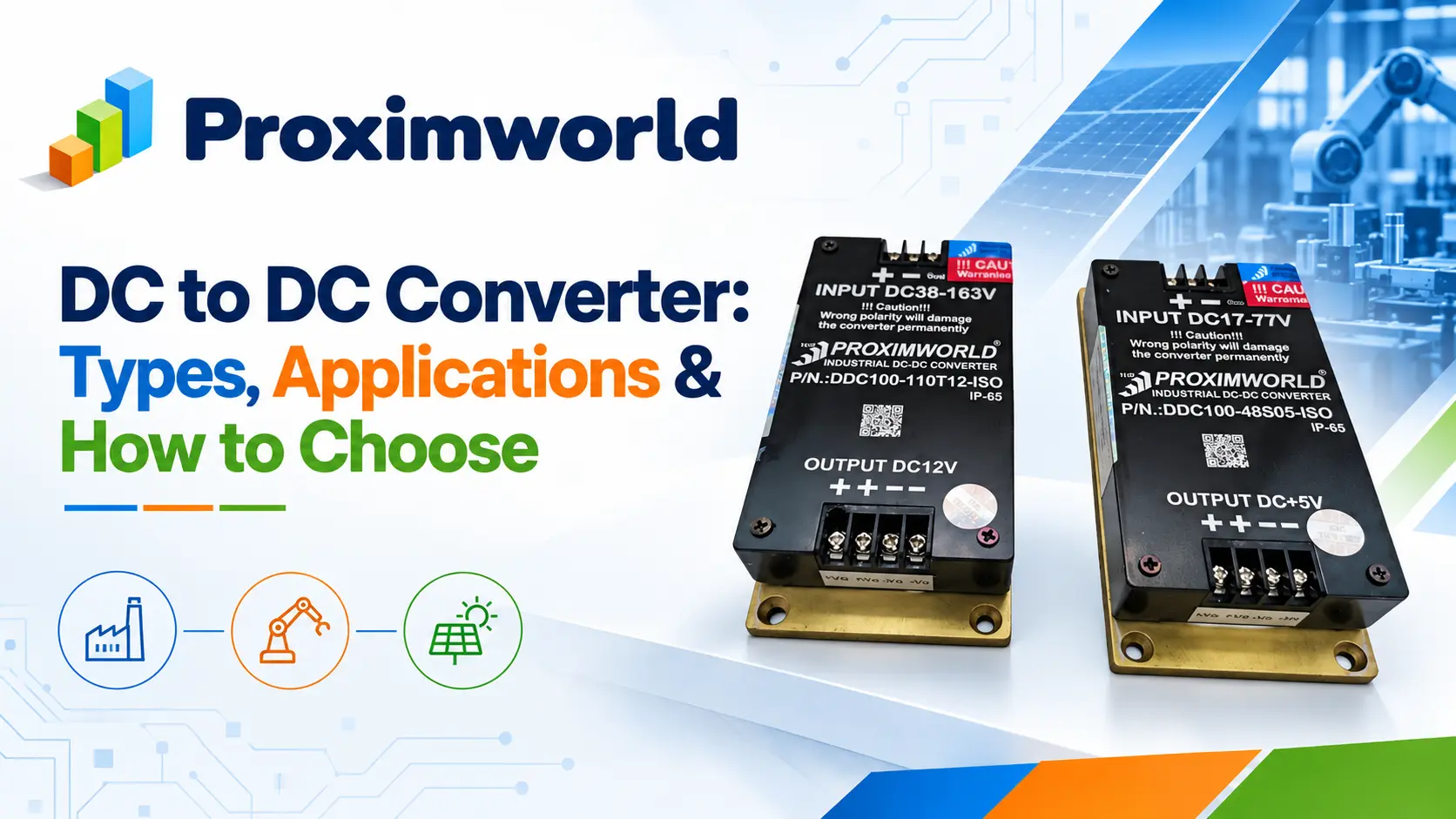
Most industrial and electronic systems do not run on a single DC voltage. A control panel may need 24V for its PLC, 12V for its sensors, and 48V for its communication rack — all from the same battery bank or power bus. This is where a DC to DC converter becomes essential. It takes an available DC input and produces a different, regulated DC output, allowing engineers to power multiple sub-systems from one power source without redesigning the entire electrical architecture.
A DC-DC converter is used wherever a stable, correctly-scaled voltage is required from a source that is unregulated, fluctuating, or simply at the wrong level — including industrial automation, telecom infrastructure, railway systems, automotive electronics, solar installations, battery-powered equipment, EV platforms, and control panels. Because the input source in these environments is rarely a clean, fixed voltage, a properly selected DC to DC power converter (or DC voltage converter) directly affects equipment reliability, safety, and service life.
This guide explains how DC to DC converters work, the main converter topologies, the specifications that matter during selection, and how to apply this knowledge across industrial, automotive, railway, telecom, and renewable energy systems.
A DC to DC converter is a power electronics circuit that accepts a DC input voltage and produces a different, regulated DC output voltage. It can step voltage down, step it up, or do both, depending on the topology and the requirement of the connected load.
The basic signal flow looks like this:
Input DC Voltage → Power Switching / Conversion Stage → Regulation → Required DC Output Voltage
A DC to DC converter is different from a simple linear regulator. A linear regulator reduces voltage by dropping the excess as heat across a series pass element, which is simple but inefficient when the difference between input and output voltage is large. A switching-based DC to DC converter instead controls energy transfer using rapid switching, an inductor or transformer, and a feedback loop — allowing it to convert voltage with significantly less wasted heat, particularly at higher power levels.
| Feature | DC to DC Converter | Linear Regulator |
|---|---|---|
| Efficiency | Generally high, since energy is switched rather than dissipated | Lower when input-output voltage difference is large |
| Heat Generation | Comparatively lower for the same power throughput | Higher, as excess voltage is dissipated as heat |
| Voltage Conversion | Can step up, step down, or invert voltage | Can only step down voltage |
| Typical Applications | Industrial, telecom, railway, automotive, EV, renewable energy systems | Low-power, low-noise analog or reference circuits |
| Power Handling | Suitable for low to high power levels | Generally limited to lower power levels |
While internal designs vary by topology, most DC to DC converters follow a similar operating sequence:
This closed-loop control is what allows a DC to DC converter to maintain a consistent output even when the input voltage drifts — for example, as a battery discharges from full charge down to its cut-off voltage.
DC to DC converters are generally classified by the direction of voltage conversion and by whether the input and output share a common electrical reference.
A buck converter steps the input voltage down to a lower output voltage. It is commonly used when the source voltage is higher than what the load requires — for example, converting a 24V supply down to 12V or 5V for sensors, controllers, and logic circuits.
A boost converter steps the input voltage up to a higher output voltage. This topology is useful when a lower-voltage source, such as a partially discharged battery, must supply a load that needs a higher, stable voltage.
A buck-boost converter can step voltage either up or down from the same input. This is important in applications where the input voltage may fall below or rise above the required output voltage during operation — a common scenario in battery-powered systems where the battery voltage varies across its charge cycle.
An isolated DC to DC converter uses a transformer to create galvanic isolation between the input and output circuits — meaning there is no direct electrical connection between the two sides. This is important in applications where safety separation, noise isolation, or protection against ground-loop and fault propagation is required, such as in industrial control systems, telecom equipment, and railway electronics.
A non-isolated converter shares a common ground reference between input and output. These designs are typically simpler, more compact, and more cost-effective, and are suitable for applications where galvanic isolation is not a safety or design requirement.
| Converter Type | Main Function | Typical Use |
|---|---|---|
| Buck | Steps voltage down | Powering lower-voltage loads from a higher-voltage bus |
| Boost | Steps voltage up | Raising a low battery voltage to a required system level |
| Buck-Boost | Steps voltage up or down | Battery systems where input voltage varies above and below the output |
| Isolated | Converts voltage with galvanic separation | Industrial, telecom, railway, and safety-critical circuits |
| Non-Isolated | Converts voltage with shared ground | Compact boards and systems without isolation requirements |
Every converter is rated for a minimum, nominal, and maximum input voltage. The selected converter must comfortably handle the full real-world input range of the source — including battery sag under load, charging peaks, and transient spikes — not just the nominal value.
Output voltage may be fixed (a single set value) or adjustable within a defined range. Confirm whether the connected load needs a precise fixed voltage or some flexibility for fine-tuning.
Power rating is calculated using the basic relationship:
Power (W) = Voltage (V) × Current (A)
Beyond the steady-state load, designers should account for startup inrush current, transient or peak loads, and an adequate safety margin so the converter is not operated at the edge of its rated capacity continuously.
Efficiency indicates how much input power is delivered as usable output power, with the remainder lost as heat:
Efficiency (%) = (Output Power ÷ Input Power) × 100
Higher efficiency generally means less heat to dissipate, which can simplify thermal management and enclosure design.
Output regulation describes how well the converter holds its output voltage steady as load current or input voltage changes. Tighter regulation is important for sensitive electronics that are affected by voltage variation.
Where safety separation or noise isolation between circuits is required by the application or by relevant standards, an isolated topology should be selected. Where isolation is not required, a non-isolated design may be more compact and cost-effective.
Ripple is the residual AC variation riding on the DC output. Communication equipment, measurement instruments, and other noise-sensitive electronics generally require lower ripple and noise levels than general-purpose control loads.
Depending on the model and manufacturer, DC to DC converters may include protection features such as:
Available protection features vary by product and series, so specific protection functions should always be confirmed against the individual product datasheet rather than assumed.
Industrial automation systems commonly draw power from multiple DC rails at once. A DC to DC converter allows a single incoming supply to be adapted for different sub-systems, including:
In these environments, stable and correctly regulated DC power directly affects measurement accuracy, control-loop stability, and equipment uptime — making converter selection an important part of overall system reliability, not just a wiring convenience.
Automotive electrical systems often need to bridge between the vehicle’s main battery voltage and the voltage required by specific modules. Typical uses include:
Automotive-facing converters generally need to tolerate voltage transients, vibration, and a wide operating temperature range, since supply voltage in a vehicle can fluctuate during cranking, charging, and load switching.
Railway systems present a demanding electrical environment, with wide and sometimes rapid variation in onboard DC bus voltage. DC to DC converters are used to support:
For railway use, input-voltage variation, long-term reliability, thermal performance under enclosed or semi-enclosed mounting, and — where required — galvanic isolation are especially important selection factors, given the safety-critical nature of many onboard systems.
Telecom infrastructure typically runs on centralized DC power (commonly -48V DC systems), with individual equipment often requiring different voltage levels. Common applications include:
Because communication equipment is sensitive to voltage noise and interruption, stable, low-ripple DC conversion is important for maintaining signal integrity and consistent equipment operation.
Renewable energy and battery-based systems frequently involve DC voltages that shift with charge state, temperature, and load. DC to DC converters are used in:
In these applications, the converter must be matched to the real operating voltage range of the battery or solar source (not just its nominal rating), along with the required power level, efficiency target, and the thermal environment the converter will be mounted in.
Selecting a converter is a structured process. The following steps provide a practical framework:
Identify the minimum, nominal, and maximum voltage the source can realistically produce, including sag and transients.
Confirm the exact voltage the connected load needs, and whether any tolerance or adjustability is required.
Determine the continuous current draw of the load, plus any inrush or peak current during startup.
Use Power = Voltage × Current, and add a reasonable safety margin above the calculated figure.
Decide whether galvanic isolation is mandatory for safety, standards compliance, or noise separation.
Review efficiency at the expected operating load, since efficiency can vary with load percentage.
Confirm that ripple and load/line regulation figures suit the sensitivity of the connected electronics.
Account for ambient temperature range, vibration, humidity, and dust or enclosure requirements.
Confirm which protection functions (OVP, OCP, SCP, thermal, reverse polarity) are included, based on the datasheet.
Check mounting style — PCB-mount, chassis-mount, DIN rail, or enclosed module — against the available space and installation method.
| Requirement | What to Check |
|---|---|
| Input | Voltage range (min/nominal/max) |
| Output | Voltage and current requirement |
| Load | Continuous current plus peak/inrush current |
| Power | Required wattage with safety margin |
| Isolation | Required or not required |
| Efficiency | Matched to application heat/power budget |
| Environment | Temperature, vibration, dust/moisture exposure |
| Protection | OVP / OCP / SCP / thermal protection |
| Mounting | PCB / chassis / DIN rail / enclosed module |
Proximworld Global Corp manufactures a range of DC to DC converters covering approximately 15W to 500W, with single and dual output configurations and wide input voltage ranges to support common 12V, 24V, and 48V system architectures. The current lineup includes:
These series cover different power levels, input ranges, and output configurations, so the right choice depends on the specific voltage, load, and environmental requirements of your system. We recommend reviewing the individual product specification page for each model before finalizing a selection, since exact ratings and features vary by series.
Explore Proximworld DC to DC Converters
| Series / Product | Power | Input Range | Output Options | Application Notes |
|---|---|---|---|---|
| 15W Series (IDC15-M) | 15W | DC+8–37V or DC+17–76V | Refer to product datasheet | Compact loads, control panels |
| 30W Series | 30W | DC+8–37V or DC+17–76V | Single output | Refer to product datasheet |
| 30W to 60W Series | 30W–60W | DC+8–37V or DC+17–76V | Single and dual output | Refer to product datasheet |
| 60W Series | 60W | DC+8–37V or DC+17–76V | Single output | Refer to product datasheet |
| 100W Series | 100W | DC+8–40V or DC+38–163V | Single and dual output | Refer to product datasheet |
| 150W Series | 150W | DC+8–40V or DC+38–163V | Single and dual output | Refer to product datasheet |
| 250W Series | 250W | DC+8–40V or DC+38–163V | Single and dual output | Refer to product datasheet |
| 500W Series | 500W | Refer to product datasheet | Single output | Higher-power loads, battery banks |
| 24V to 12V Converter | 120W | 24VDC | 12VDC, 1–10A | 24V to 12V system bridging |
| 24V to 24V Converter | Refer to product datasheet | 24VDC | 24VDC, 1–20A | Isolation/regulation within a 24V bus |
| 48V to 24V Converter | 240W | 48VDC | 24VDC, 1–10A | 48V to 24V system bridging |
| 48V to 48V Converter | 480W | 48VDC | 48VDC, 1–10A | Isolation/regulation within a 48V bus |
Specifications above are based on information published on the Proximworld product category page at the time of writing. Always verify exact ratings, tolerances, and protection features on the individual product page before making a purchasing decision.
Tap a question to expand the answer.
A DC to DC converter is a power electronics device that converts one DC voltage level into another regulated DC voltage. It can step voltage up, step it down, or do both, allowing a single power source to supply multiple loads that require different voltages.
It regulates and adapts DC power so that sensitive equipment receives a stable voltage even when the source voltage fluctuates. This is important in battery-powered, automotive, industrial, and renewable energy systems where input voltage rarely stays constant.
A linear voltage regulator only steps voltage down and dissipates the excess as heat, making it inefficient for large voltage differences. A DC to DC converter uses switching techniques to convert voltage more efficiently and can step voltage up, down, or both.
A buck converter is a type of DC to DC converter that reduces a higher input voltage to a lower, regulated output voltage. It is commonly used to power lower-voltage electronics from a higher-voltage supply.
A boost converter is a type of DC to DC converter that increases a lower input voltage to a higher, regulated output voltage. It is often used when a battery voltage drops below the level required by the connected load.
An isolated DC to DC converter uses a transformer to electrically separate its input and output circuits. This isolation is used for safety, noise reduction, and protection against fault propagation, and is common in industrial, telecom, and railway systems.
Start by identifying the input voltage range, required output voltage, load current, and total power requirement. Then confirm isolation needs, efficiency, ripple/regulation tolerance, environmental conditions, protection features, and the required mounting format.
Multiply the required output voltage by the maximum expected load current (Power = Voltage × Current), then add a safety margin to account for startup inrush and transient loads rather than sizing the converter at its exact calculated limit.
Efficiency is the percentage of input power that is successfully delivered as output power, calculated as (Output Power ÷ Input Power) × 100. Higher efficiency generally results in less heat generation and simpler thermal management.
Yes. DC to DC converters are widely used in industrial automation to power PLCs, sensors, control panels, robotics, and machine control electronics from a shared DC power source, making an industrial DC to DC converter a common requirement in factory and control-panel design.
Yes. Automotive systems use DC to DC converters to power control units, lighting, sensors, and communication equipment from the vehicle’s main battery voltage, while accommodating voltage transients typical of vehicle electrical systems.
Confirm the input voltage range, required output voltage and current, total power with margin, isolation requirement, efficiency, ripple and regulation specifications, operating temperature range, available protection features, and the mounting or form-factor requirement of your application.
Choosing the right DC to DC converter comes down to a clear understanding of the application: the real-world input voltage range, the exact output voltage and current the load needs, and the total power requirement with an adequate safety margin. From there, efficiency, isolation, ripple and regulation, and environmental conditions determine which topology and product series are suitable — whether the system is an industrial control panel, a railway signaling unit, a telecom cabinet, a solar installation, or an EV auxiliary circuit.
Because no two applications draw power in exactly the same way, converter selection should always be checked against the specific datasheet of the chosen model rather than general assumptions. Proximworld’s DC to DC converter range spans 15W to 500W across multiple input and output configurations, offering a starting point for engineers and procurement teams evaluating options for their next project.

Leave a comment