
No products in the cart.

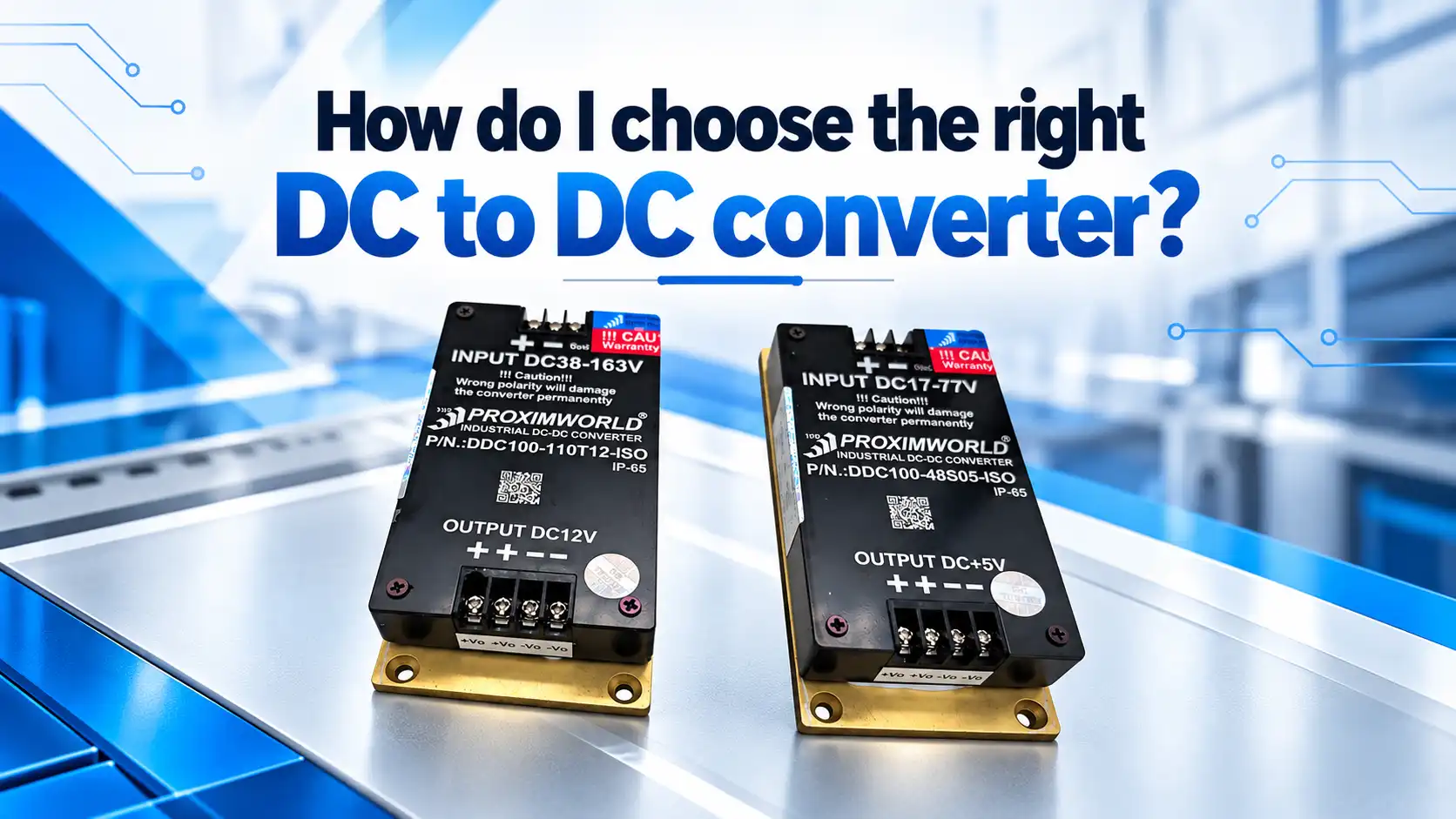
Choosing the wrong DC to DC converter is an expensive mistake. It can trip under load, overheat in an enclosure, or fail after the first voltage spike. The right choice comes down to a few numbers: your input voltage range, the output you need, the power involved, and the environment it will run in. This guide walks through each step so you can shortlist the right converter with confidence.
Table of Contents
To choose the right DC to DC converter, match it to your input voltage range, output voltage and current, and isolation requirement, then confirm it suits your operating environment.
Simple rule: pick a converter whose input range covers your worst-case source voltage, whose output current is at least 20–30% above your load, and which is isolated whenever safety or noise matters.
To compare ready-made options against these criteria, you can browse the DC to DC converter range and check each model’s datasheet.
A DC to DC converter changes one DC voltage level into another and regulates the result. A battery bank might supply 48V while a controller needs 12V or 24V. The converter bridges that gap and keeps the output stable even when the input varies.
Most modern units are switching converters. They switch power on and off at high frequency, store energy briefly in an inductor or transformer, and smooth the output with a capacitor. This is far more efficient than a linear regulator, especially when the input and output voltages are far apart.
Always rely on the manufacturer’s datasheet for exact ratings rather than assuming from the model name alone.
| Type | What It Does | Example | Best For |
|---|---|---|---|
| Buck (step-down) | Output is lower than input | 48V to 12V | Powering controllers and sensors from a higher-voltage bus |
| Boost (step-up) | Output is higher than input | 12V to 24V | Low-voltage batteries driving higher-voltage loads |
| Buck-boost | Holds a stable output whether input is above or below it | 9–36V in, 12V out | Vehicles and batteries with wide voltage swings |
| Isolated | Transformer separates input from output electrically | 110V in, 24V out | Railway, industrial, telecom, and safety-critical systems |
| Non-isolated | Shares a common ground between input and output | 24V to 5V | Board-level power and low-risk applications |
Non-isolated converters share a common ground between input and output. They are typically smaller, cheaper, and more efficient, which suits board-level power and low-risk applications.
Isolated converters use a transformer, so there is no direct electrical path between input and output. This protects sensitive circuits from surges, breaks ground loops, reduces noise, and is often required for safety or regulatory reasons. If your system touches high-voltage buses, long cable runs, or communication lines, isolation is usually the safer choice.
Not sure which DC to DC converter fits your system?
Share your input voltage, output requirement, and application, and the ProximWorld team can help you shortlist a suitable solution.
Start with your input voltage range, required output voltage and current, and whether you need isolation. Then add power headroom, check the operating temperature, and confirm the protections and mounting style against the datasheet.
A buck converter steps voltage down, so the output is lower than the input. A boost converter steps voltage up, so the output is higher than the input.
A common rule is to size the converter so the load uses about 70–80% of its rated output. Loads with high start-up current, such as motors, may need more margin.
Choose isolation when safety, ground separation, or noise immunity matters, such as in railway, industrial, and telecom systems. For simple, low-risk board-level power, non-isolated converters are often enough.
Yes. Pick a converter with a wide input range, or a buck-boost type if the battery voltage can fall below and rise above the required output.
Common causes include running near full load, high ambient temperature, poor airflow, or low efficiency at your operating point. Choosing a higher rating or improving ventilation usually helps.
Generally yes, since it means less wasted heat and lower energy loss. However, compare efficiency at your actual load level, because it varies with load and input voltage.
Look for over-voltage, over-current, over-temperature, and short-circuit protection. Industrial and railway applications may also need surge and reverse-polarity protection.

Leave a comment