
No products in the cart.

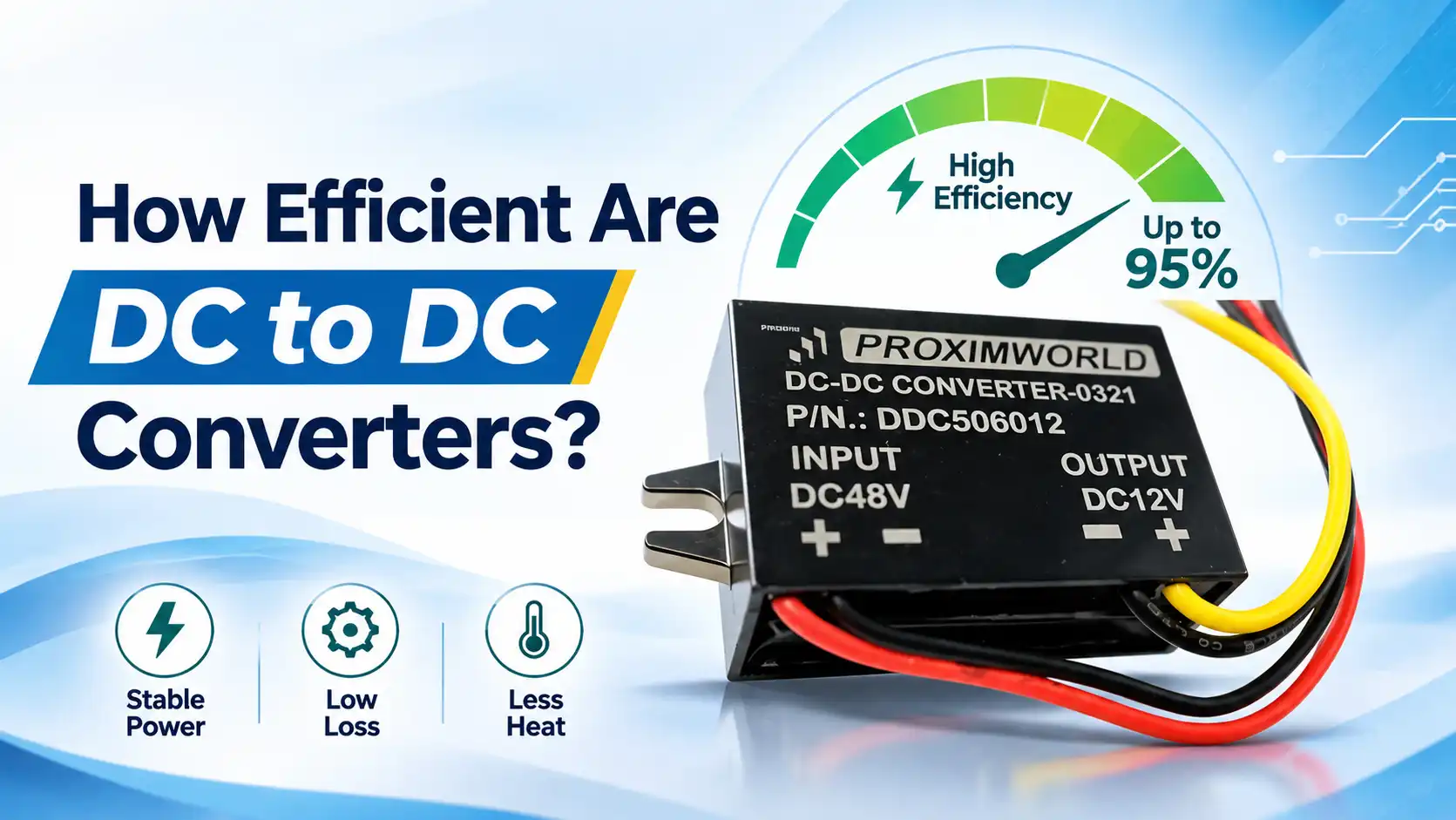
Efficiency is one of the most important numbers on a converter datasheet, yet it is often misunderstood. It decides how much heat the unit produces, how much energy you waste and how large the enclosure and cooling need to be. This guide explains how efficient DC to DC converters are, what changes that figure and how to read it correctly before you buy.
Table of Contents
Modern switching DC to DC converters are generally efficient, and many reach the high 80s to mid 90s in percent at a good operating point. The exact figure depends on the converter type, the load, the input and output voltages and the temperature, so the datasheet curve for your conditions matters more than a single headline number.
To compare ready-made options against these criteria, you can browse the DC to DC converter range and check each model’s datasheet.
Efficiency is the share of input power that reaches the output. The rest is lost, mostly as heat. It is calculated as output power divided by input power, shown as a percentage.
For example, a converter delivering 100W to a load while drawing about 111W from the source is roughly 90% efficient. The missing 11W turns into heat inside the unit, which is why a small gain in efficiency can mean a large drop in heat.
| Type | General efficiency | What drives it | Best For |
|---|---|---|---|
| Linear regulator | About output voltage ÷ input voltage | Burns off the voltage difference as heat | Very low power or very small voltage drops |
| Non-isolated buck or boost | Often around 90% to the mid 90s | Switching and conduction losses | Board-level power and low-risk applications |
| Buck-boost | Often slightly lower than a simple buck or boost | More switching stages when input spans the output | Batteries and vehicles with wide voltage swings |
| Isolated | Often in the high 80s to low 90s | Transformer and rectifier losses | Railway, industrial, telecom and safety-critical systems |
These are general ranges, not guarantees. Always rely on the manufacturer’s datasheet for exact ratings. As a quick check, a linear regulator dropping 24V to 5V is only about 21% efficient, which is why switching converters dominate wherever power matters.
Every lost watt becomes heat, and heat shortens component life and forces larger heatsinks or derating. The table below shows a simple calculation for a load that needs 100W at the output.
| Efficiency | Input power needed | Power lost as heat | What it means |
|---|---|---|---|
| 85% | About 117.6W | About 17.6W | More heat to remove and more energy drawn from the source |
| 90% | About 111.1W | About 11.1W | A common mid-range result |
| 95% | About 105.3W | About 5.3W | Roughly one third of the heat of an 85% unit |
On battery or solar systems, lower losses also mean more usable energy and longer runtime. In sealed enclosures, they can mean the difference between a cool unit and one that derates in summer.
Share your input voltage, output requirement and application, and the ProximWorld team can help you shortlist a suitable solution.
Many modern switching converters reach the high 80s to mid 90s in percent at a good operating point. The actual figure depends on the converter type, load, voltage ratio and temperature.
It depends on the type and power level. Higher is generally better, but compare efficiency at your actual load and input voltage rather than the peak value.
They are often slightly less efficient than non-isolated designs because of transformer and rectifier losses. The trade-off is safety, noise separation and protection from surges.
Some losses, such as switching and control circuit consumption, stay roughly constant. At light load they make up a larger share of the power, so the percentage falls.
Divide output power by efficiency to get input power, then subtract output power. For example, 100W at 90% efficiency needs about 111W in and produces about 11W of heat.
Yes, for very low power or very small voltage drops where simplicity and low noise matter. For larger voltage differences, a switching converter wastes far less energy.
Yes. Higher temperatures raise resistance and can reduce efficiency and available output power, so check derating curves for your operating conditions.
Generally yes, since it means less wasted heat and lower energy loss. However, compare efficiency at your actual load level, because it varies with load and input voltage.

Get the latest updates on power conversion solutions, new products, and industrial innovations. DC-DC Converters | DC-AC Converters | AC-DC Converters
No spam, ever. Unsubscribe at any time.
Thanks for joining. We're glad you're here.
Leave a comment