
No products in the cart.

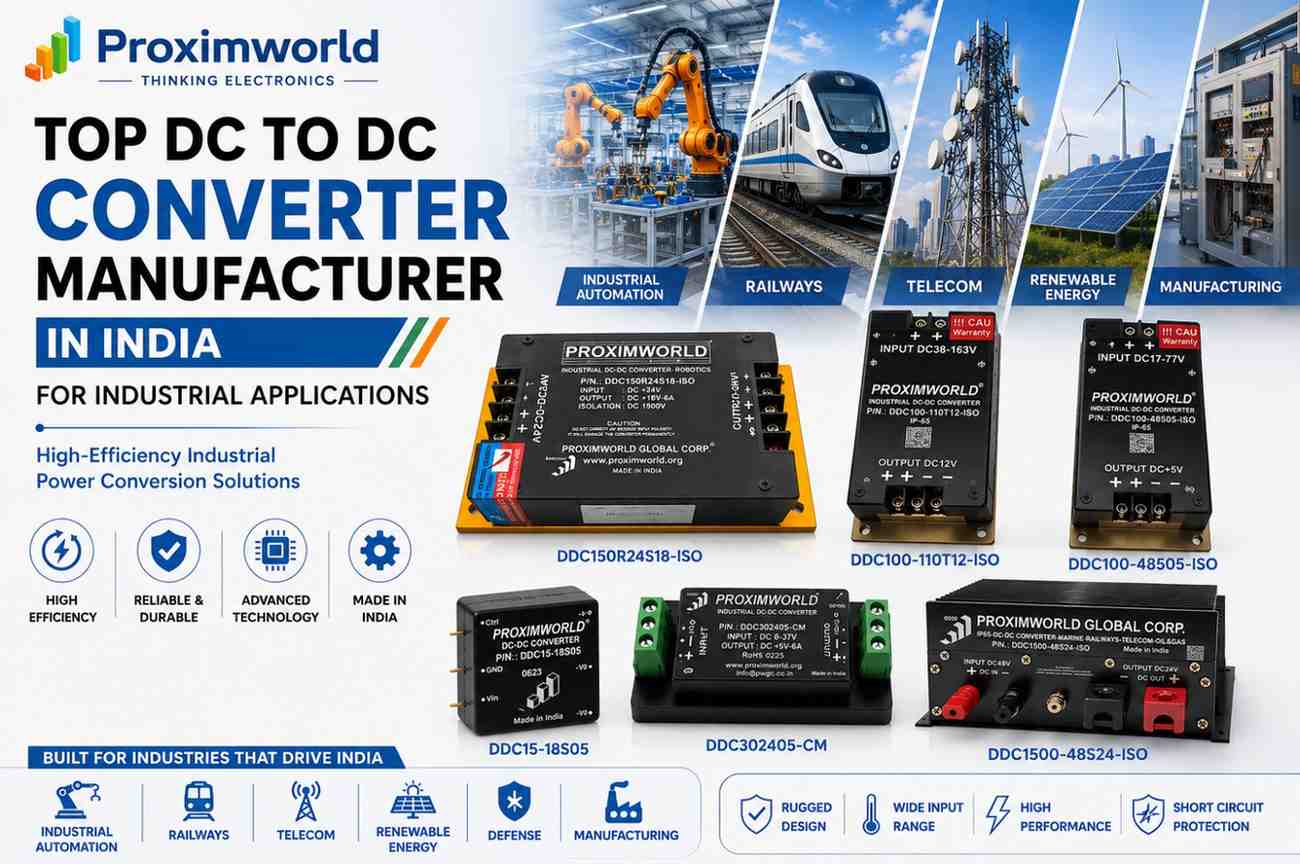
In today’s power-critical industrial landscape, a reliable DC to DC converter is not just a component — it is the backbone of efficient, uninterrupted power delivery
across automation systems, telecommunication infrastructure, renewable energy installations, and embedded electronics. As India’s industrial sector accelerates under initiatives like Make in India and the National Electronics Policy, the
demand for high-quality, locally manufactured DC to DC converters has never been stronger.
Whether you need a compact 15W module for an embedded device or a robust 500W converter for heavy industrial equipment, finding the right DC to DC converter manufacturer in India is critical. This guide explores everything you need to know — from converter types and industrial applications to selection criteria and Proximworld’s comprehensive product range.
DC to DC converters are classified based on their topology, isolation characteristics, and conversion direction. Understanding each type is essential for selecting the right power conversion solution for your industrial application.
A buck converter reduces a higher DC input voltage to a lower DC output voltage. It is the most widely used topology in industrial electronics, powering microcontrollers, sensors, and control systems from a higher-voltage bus. Buck converters
operate at high efficiency — often above 90% — making them the preferred choice for battery-powered systems and energy-sensitive applications.
Boost converters perform the inverse function, stepping up a lower DC input to a higher DC output. They are commonly found in renewable energy systems, where battery or solar panel voltages need to be elevated for grid-tie or motor drive applications.
Industrial boost converters from Proximworld support wide input ranges to accommodate varying source voltages.
As the name suggests, a buck-boost converter can both step up and step down the output voltage relative to the input. This makes it especially valuable in applications with variable input sources — such as battery-operated equipment where the
supply voltage fluctuates significantly during discharge cycles.
Isolated converters use transformer-based topologies (flyback, forward, push-pull, full bridge) to provide galvanic isolation between input and output. This isolation is critical in medical devices, industrial control panels, and communication
equipment where ground loops or noise coupling must be eliminated. Isolated DC to DC converters are essential in high-safety environments.
Non-isolated converters (buck, boost, buck-boost) share a common ground between input and output. They are simpler, more compact, and more cost-effective — ideal for applications within a single system where isolation is not required.
India’s power electronics manufacturing sector has experienced significant momentum over the past decade. Several structural and economic factors make India an increasingly competitive source for industrial-grade DC to DC converters.
The Indian power electronics market is projected to grow at a CAGR of over 12% through 2030, driven by rapid electrification, EV adoption, and industrial automation. Sourcing from reliable domestic DC to DC converter suppliers in India ensures supply chain continuity while supporting national manufacturing goals.
Proximworld offers a comprehensive lineup of industrial-grade DC to DC converters covering power outputs from 15W to 500W, with both
single and dual output configurations and wide input voltage ranges suited to a diverse range of industrial use cases.
The full range is available at Proximworld’s DC to DC Converter product page, with detailed specifications, input/output voltage parameters, and pricing for each series.
Selecting a DC to DC converter for industrial deployment requires careful evaluation of technical specifications and protection features. Here are the most critical parameters
every buyer should assess.
Industrial environments often involve variable or wide-range input voltages — from battery-based systems with fluctuating charge levels to solar arrays with irradiance-dependent output. A converter with a wide input voltage range (e.g., DC +8–40V
or DC +38–163V) provides greater operational flexibility and resilience against supply fluctuations.
Precision in output voltage is critical for sensitive loads such as PLCs, communication modules, and measurement instrumentation. Look for converters with tight output regulation specifications — typically ±1% or better — to ensure stable, reliable
power delivery under varying load conditions.
Efficiency directly affects heat generation, energy costs, and system reliability. Industrial-grade converters from reputable manufacturers typically achieve efficiencies of 85% to 93%, significantly reducing thermal management requirements and
extending component lifespan in enclosed installations.
Robust protection circuits are non-negotiable in industrial applications. Essential protection mechanisms include:
Dual-output converters provide two independent regulated output rails from a single unit — simplifying designs that require both positive and negative supply rails, or two different voltage levels. This reduces component count, PCB space, and
system complexity in sophisticated power architectures.
Industrial converters are available in DIN-rail mountable enclosures, open-frame modules, enclosed chassis-mount units, and PCB-mount formats. The correct choice depends on your installation environment — enclosure size, heat dissipation path,
and accessibility requirements all factor into the decision.
DC to DC converters are used across virtually every sector of modern industry. Understanding where and how they are deployed highlights the breadth of their importance in contemporary power systems design.
Programmable logic controllers, sensors, actuators, and HMI panels require stable, regulated DC power. DC to DC converters provide isolated, noise-free supply rails that protect sensitive control electronics from power bus fluctuations
in factory environments.
Network routers, base stations, fiber optic equipment, and remote radio units rely on DC power conversion — typically from 48V bus systems to 12V, 5V, or 3.3V for active electronics. High-efficiency converters minimize heat in densely
packed telecom enclosures.
EV charging systems, battery management units, and onboard vehicle electronics require precise voltage conversion across wide input ranges. DC to DC converters bridge high-voltage traction batteries with low-voltage auxiliary systems.
Maximum power point tracking (MPPT) circuits, battery charge controllers, and solar inverters all use DC to DC conversion stages. Wide-input converters are essential to handle the variable output of photovoltaic panels across different
light conditions.
Military communication systems, avionics, and shipborne electronics demand ruggedized, isolated converters with MIL-STD compliance. High reliability, wide operating temperature range, and vibration resistance are critical specifications
in this sector.
Rolling stock electronics, passenger information systems, HVAC controls, and traction power auxiliaries all depend on DC to DC converters that can withstand wide input voltage swings and harsh electromagnetic environments typical of
railway applications.
Medical devices require isolated power conversion to meet patient safety standards and eliminate ground loop interference. DC to DC converters with reinforced or functional isolation are integral to diagnostic imaging, patient monitoring,
and laboratory equipment.
The choice between isolated and non-isolated topologies is one of the most consequential decisions in power system design. This comparison helps clarify which type best fits your application requirements.
Proximworld offers both isolated and non-isolated DC to DC converter configurations across its product range, enabling engineers to select the most appropriate topology
for their specific industrial deployment.
With dozens of models and specifications available, selecting the optimal DC to DC converter requires a structured evaluation process. Follow this decision framework to
ensure you specify the right solution from the outset.
Begin by calculating total load power in watts (P = V × I). Add a 20–30% margin to your calculated maximum to ensure the converter operates comfortably below its rated limit — extending lifespan and improving thermal performance. For example,
if your load draws 80W at peak, select a 100W or 120W rated converter.
Identify the minimum and maximum expected input voltage from your source (battery, bus, solar, etc.) and the precise regulated output voltage your load requires. Ensure the converter’s specified input range fully covers your supply’s variation
envelope — not just its nominal value.
If your application involves patient safety, electrical safety standard compliance (IEC/EN), or noise isolation between subsystems, specify an isolated topology. For same-board power rail conversion in a single-ground system, non-isolated converters
offer a simpler, more cost-effective solution.
Review the manufacturer’s protection features: short-circuit, over-voltage, over-current, and over-temperature protection are the baseline minimum for industrial use. Additionally, check MTBF (Mean Time Between Failures) ratings and operating
temperature range to ensure compatibility with your installation environment.
Match the converter’s physical format to your enclosure constraints and cooling strategy. Convection-cooled enclosed units suit panel-mount installations; open-frame modules work well where forced-air cooling is available; PCB-mount versions optimize
space in compact product designs.
For regulated industries (medical, defense, railway, UL-listed installations), ensure the selected converter carries the appropriate certifications — CE marking, UL/cUL, RoHS compliance, or sector-specific standards. Compliance documentation from
the manufacturer simplifies your own product certification process.
Always request a datasheet and application note from your DC to DC converter supplier before finalizing a specification. A reputable manufacturer
like Proximworld provides complete technical documentation to support your design and procurement decisions.
Proximworld has established itself as a trusted destination for industrial power conversion products in India, offering a range of DC to DC converters that balance technical performance, price competitiveness, and procurement convenience.
Browse Proximworld’s complete range of industrial DC to DC converters — from 15W to 500W, single and dual output, with wide input voltage ranges designed for demanding applications.
The right DC to DC converter is a critical enabler of reliable, efficient industrial power systems. Whether you are designing automation equipment, building a renewable
energy installation, deploying telecommunications infrastructure, or developing EV systems, the quality of your power conversion stage directly determines system stability, efficiency, and longevity.
India’s growing manufacturing capability — combined with suppliers like Proximworld offering a wide product range at competitive price points — means procurement teams and design engineers no longer need
to look beyond domestic sources for industrial-grade DC to DC converters.
With power outputs spanning 15W to 500W, wide input voltage flexibility, single and dual output options, and comprehensive protection features, Proximworld’s DC to DC converter range is engineered to meet the exacting demands of modern Indian industry. Explore the full catalogue today and get in touch with Proximworld’s technical team to find the optimal solution for your specific power conversion requirements.

Leave a comment