
No products in the cart.

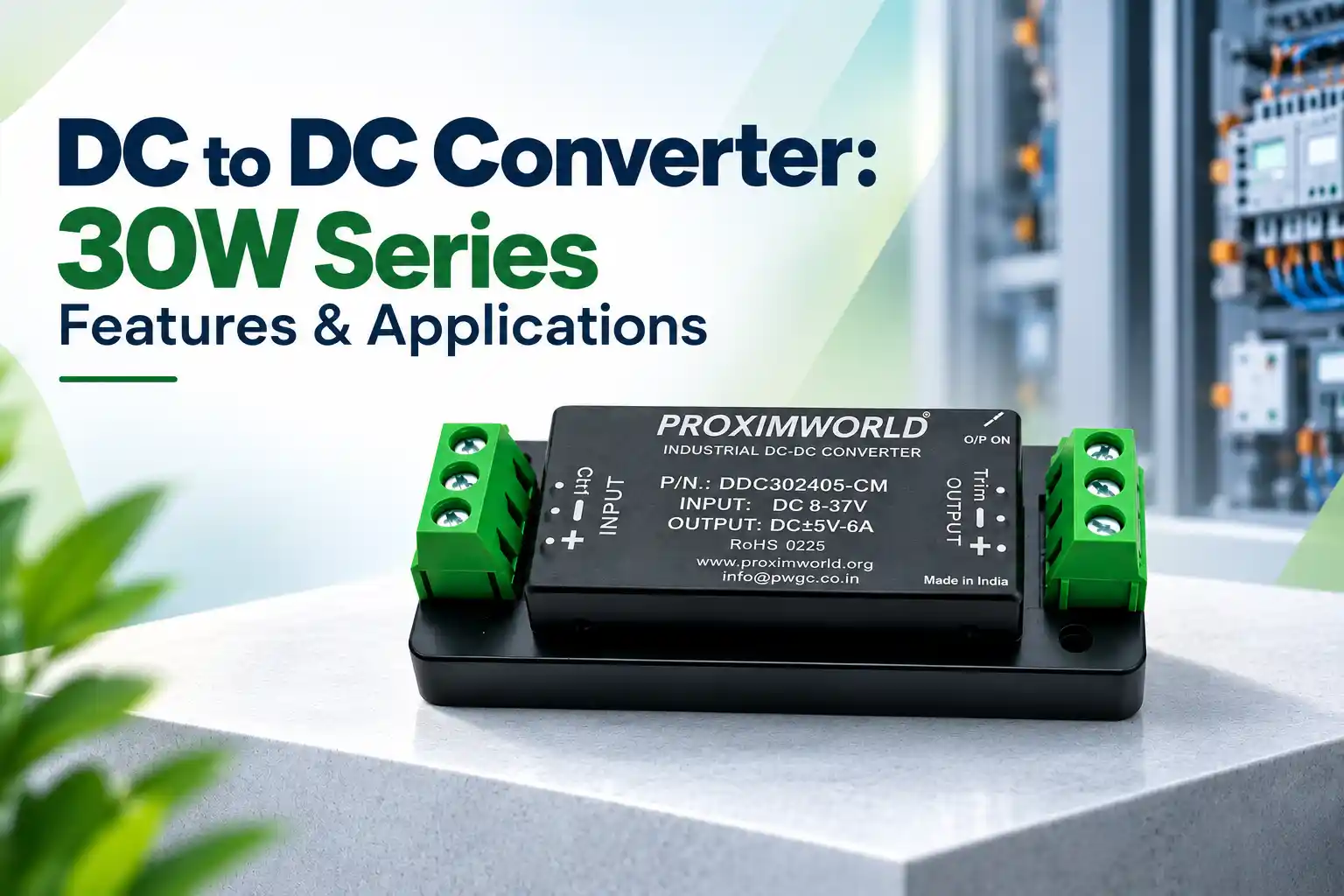
Power systems built around a 24V, 36V, or 48V DC bus typically need a smaller, precisely regulated rail to drive sensors, controllers, and communication modules. That’s where a DC-to-DC converter earns its place in a design. Proximworld’s 30W Series DC-to-DC Converter is built for exactly this kind of point-of-load conversion — compact, isolated, and ready for demanding environments. This guide covers what the specs actually mean, where the module fits, and how to size it correctly for your system.
A DC-to-DC converter is a power electronics module that converts one DC voltage level into a different, regulated DC output. Unlike a basic linear regulator — which just burns off the excess as heat — a DC-to-DC converter uses high-frequency switching and a transformer or inductor to do the job efficiently.
In practice, this means the module can step voltage up, step it down, or even invert it. Moreover, it holds the output steady regardless of input fluctuations or load changes. That’s the fundamental advantage over simpler approaches.
Most industrial designs run on a standardised DC bus — often 24V, 36V, or 48V — yet every downstream component demands its own voltage. Sensors may need 12V; a communication module might need 5V. Running a separate power supply for each is costly, wasteful, and difficult to maintain. A DC-to-DC converter solves this neatly. Furthermore, isolated converters add protection that a shared supply simply cannot offer.
The 30W Series – Single Power Output DC-to-DC Converter from Proximworld is an isolated module rated at 30W continuous output. It accepts a wide input range and delivers regulated DC through a buck-boost topology. Consequently, it handles input voltage swings — including battery sag during discharge and rise during charging — without losing output regulation.
One regulated DC rail. Simpler, lower cost, and the right choice for most single-subsystem applications.
Two independent rails from one module. Needed when your circuit requires both a positive and a negative supply.
The table below lists verified specs from the 30W Series product page. Run through each row against your own system requirements — don’t skip the input range or IP rating, as these are the two specs engineers most commonly overlook at the design stage.
| Specification | Details |
|---|---|
| Input Voltage | DC+8–37V | DC+17–76V |
| Output Power | 30W continuous |
| Output Voltage Range | Up to 48V DC (adjustable trim) |
| Standard Output Voltages | 5V · 6V · 9V · 10V · 12V · 15V · 19V · 24V · 36V · 48V |
| Isolation Type | Galvanic isolation (input ↔ output) |
| Converter Topology | Buck-Boost (step-up / step-down) |
| Mounting Options | PCB · Chassis · DIN Rail |
| Built-in Protections | Short Circuit · Overcurrent · Undervoltage · Overvoltage |
| IP Rating | IP65 — dust-tight & water jet protected |
Here’s a real-world scenario that engineers run into constantly: a control cabinet runs a PLC at 24V, proximity sensors at 12V, and a Modbus communication module at 5V — all from a single 48V bus. Without a DC-to-DC converter, you’d need three separate power supplies, three sets of wiring runs, and three failure points to manage.
Furthermore, using linear regulators to drop from 48V to 5V wastes most of the input power as heat. That’s not just inefficient — it creates a thermal management problem. In contrast, a switching converter like the 30W Series does the same job at significantly higher efficiency.
P (W) = V (V) × I (A)
A subsystem drawing 12V at 2A needs 24W. The 30W Series covers that with 6W of headroom. That margin matters — running a converter at its absolute ceiling continuously shortens its lifespan. Therefore, always target 70–80% of rated output power for continuous loads.
Each of these features addresses a specific engineering challenge. Together, they make the 30W Series a well-rounded choice for point-of-load conversion in demanding environments.
The buck-boost topology handles inputs that rise above or fall below nominal. Consequently, output voltage stays regulated even during battery charge-discharge swings.
Input and output grounds are separated. As a result, ground loops, noise coupling, and voltage transients from the primary bus cannot reach your downstream circuit.
5V through 48V DC as standard options, plus an adjustable trim feature. In most cases, one SKU covers your requirement without custom orders.
Short circuit, overcurrent, undervoltage, and overvoltage protection are all built in. Together, these guard against the most common field failure modes in industrial power systems.
Fully sealed against dust and protected against water jets. This rating means you can mount the converter in harsh industrial environments without an additional protective enclosure.
PCB, chassis, and DIN rail. Regardless of your enclosure type, you can integrate the same module without reworking the mechanical design.
The 30W Series’s combination of a wide input range, galvanic isolation, IP65 protection, and multiple mounting formats makes it a versatile fit across several industries. Below are the primary application areas where this converter is commonly specified.
Industrial Automation
Powers PLCs, sensors, actuators, and HMIs in factory automation panels and control cabinets.
Renewable Energy
Regulates voltage from solar panels and wind turbines to storage systems and electronic loads.
Telecommunications
Provides clean, isolated power for network switches, routers, and telecom base station equipment.
Transportation
Powers on-board electronics in railway vehicles, buses, and commercial fleet systems.
Medical Equipment
Supplies stable, isolated voltage rails for diagnostic and monitoring equipment.
Test & Measurement
Powers data acquisition systems and precision instrumentation where supply noise must be minimised.
There are seven key parameters to verify before committing to a converter. Working through each step in order prevents the most common specification mistakes engineers make under deadline pressure.
Confirm Your Input Voltage Window
Map your bus voltage range — including worst-case sag and peak — against DC+8–37V or DC+17–76V. Also account for inrush during startup.
Calculate Total Load Power
Use P = V × I for each load. Sum them up. Leave at least 20% headroom below the converter’s 30W rating for continuous operation.
Decide Whether Isolation Is Required
If your downstream circuit shares a ground with noisy equipment, isolation is essential — not optional. The 30W Series provides galvanic isolation by design.
Select the Output Voltage
Match your subsystem to one of the 10 standard outputs: 5V, 6V, 9V, 10V, 12V, 15V, 19V, 24V, 36V, or 48V. Use the adjustable trim for fine-tuning.
Choose a Mounting Format
PCB for embedded boards, chassis for standalone enclosures, DIN rail for control cabinets. All three formats are available in the 30W Series.
Review Built-in Protections
Short circuit, overcurrent, undervoltage, and overvoltage protection are built in. Together, they reduce field failures without adding external protection components.
Verify the Environmental Rating
IP65 means fully dust-tight and water jet resistant. Confirm your installation environment matches — or betters — this rating before finalising the design.
Getting the electrical specification right is only half the work. Several system-level factors are often overlooked at the installation stage and can undermine performance even when the converter is correctly specced.
Wire Gauge Sizing
Undersized cables drop voltage before the input and produce heat at the output. Size both input and output wiring for the full expected current — not just the nominal load.
Grounding Both Sides
Because the 30W Series is galvanically isolated, grounding practices on both the input and output sides matter. Skipping output-side grounding is a common mistake that wastes the isolation benefit entirely.
Thermal Placement
Even with IP65 protection, the module still needs airflow. Avoid mounting directly next to high-power components or in sealed dead zones within the enclosure.
Mounting Format Match
Select PCB, chassis, or DIN rail based on your enclosure’s mechanical constraints. In high-vibration environments, additionally confirm that the mounting hardware provides enough mechanical support.
Output Voltage — Order the Right Variant
The 30W Series is available in specific standard output voltages. The adjustable trim feature only covers a limited range — it does not substitute for ordering the correct base voltage at the outset.
A few procurement and engineering steps are worth completing before you finalise an order. These are easy to skip under time pressure — and equally easy to regret later.
Request a Volume Quote
Single-unit sample prices don’t reflect volume pricing. If your build requires more than a handful of units, contact Proximworld’s sales team for a formal quote. Lead times may also differ at volume.
Custom Output Voltages
If your target voltage falls outside the standard list, ask about customisation directly. In some cases it’s feasible, but lead time and minimum order quantities may apply.
Test Before Full Deployment
Always validate the converter under your real load profile — not just nominal figures. Transient load behaviour, startup inrush, and thermal performance in your enclosure should all be confirmed before production.
Compliance Documentation
For regulated sectors — medical, rail, or defence — confirm what test reports and certification documentation are available for your specific ordered configuration before design sign-off.
View full technical specifications, or speak directly with Proximworld’s engineering team to confirm input range, output voltage, and mounting format for your application.
These are the questions Proximworld’s engineering team hears most often. Each answer is written to give you a direct, usable response — not a paragraph of caveats.

Leave a comment