
No products in the cart.

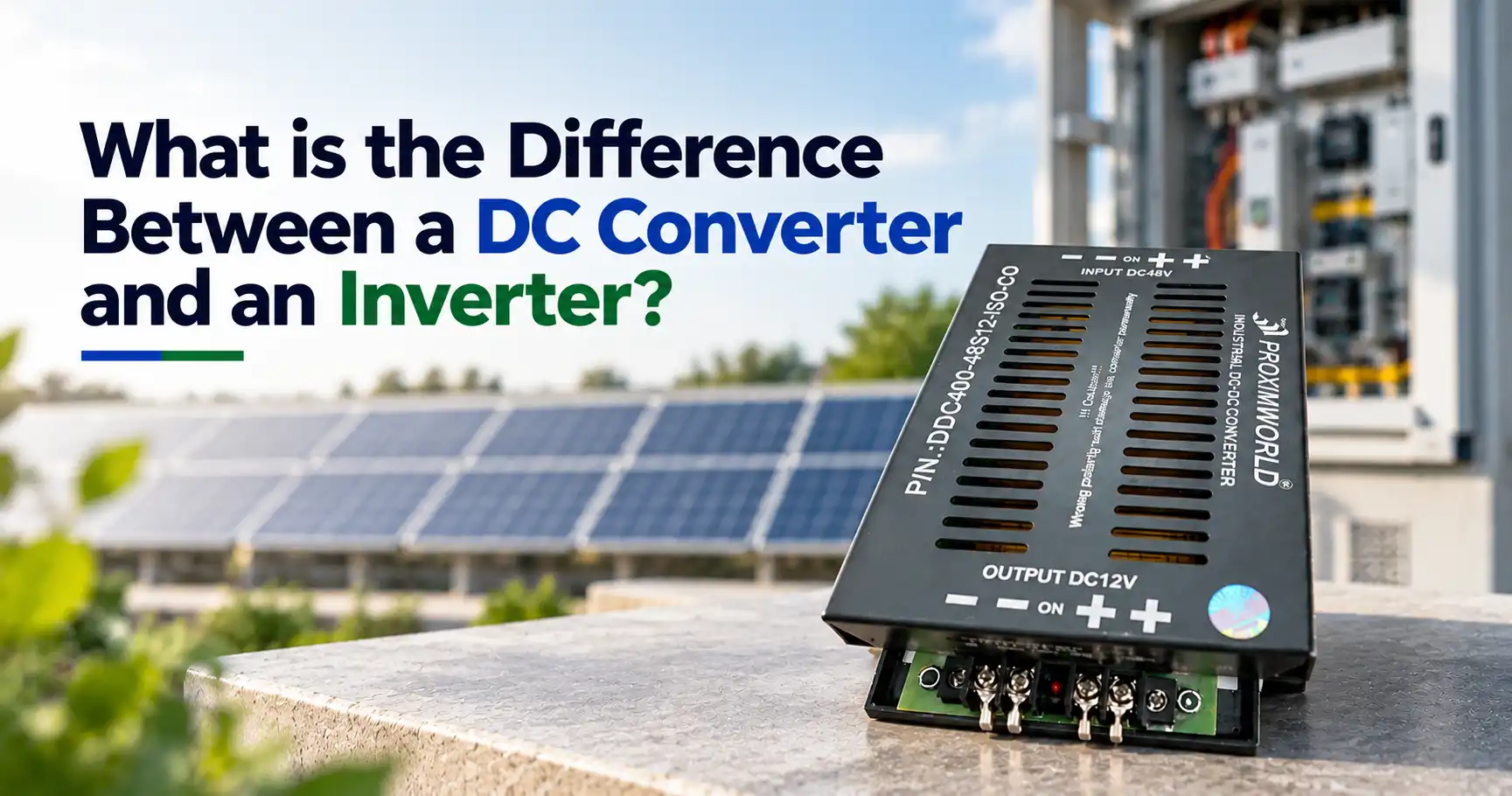
If you are specifying power electronics, you will quickly run into the DC converter vs inverter question. Both devices use fast-switching semiconductors to reshape electrical power, so they are easy to confuse. They solve different problems, though. One adjusts the level of a DC voltage. The other turns DC into AC. This guide explains how each works, where each is used, and how to pick the right one.
Table of Contents
In everyday usage, a DC converter usually means a DC-to-DC converter. It takes a DC input and delivers a DC output at a different voltage, for example 48V DC down to 12V DC. An inverter is a DC-to-AC converter. It takes DC from a battery or solar array and produces AC, such as 230V at 50 Hz.
Strictly speaking, an inverter is also a power converter. In product catalogues, though, “DC converter” almost always means DC-DC, and that is how this article uses the term. The simple rule: if both sides of the device are DC, it is a DC converter. If the output is AC, it is an inverter.
A DC converter changes one DC voltage level into another and regulates the result. A battery bank might supply 48V while a controller needs 12V or 24V. A DC converter bridges that gap and keeps the output stable even when the input varies.
Common types include:
You can browse industrial options in ProximWorld’s DC to DC converter category, which includes railway and solar-focused models.
An inverter converts DC into AC so that equipment designed for mains-type power can run from a battery or solar source. Most household and office appliances expect AC, so an inverter is the link between stored DC energy and those loads.
Inverters are often grouped by output waveform (square wave, modified sine wave, or pure sine wave) and by how they connect to the system (standalone/off-grid or grid-tied). Sensitive electronics generally run best on a pure sine wave output. Industrial inverters, including those in ProximWorld’s DC to AC converter range, are built for applications such as telecom, solar, and defence-grade systems.
A switching DC-DC converter turns a power switch (typically a MOSFET) on and off at high frequency. Energy is stored briefly in an inductor or transformer and released through a capacitor-smoothed output. A control circuit adjusts the switching duty cycle, using feedback from the output, to hold the voltage steady. Our guide on how a DC to DC converter works covers this in more depth.
An inverter also uses fast switches, but arranges them (commonly in a bridge) to alternate the direction of current through the load. Pulse-width modulation shapes the switching so that, after filtering, the output approximates a sine wave at the target frequency, such as 50 Hz. Some designs first boost the battery voltage with a DC-DC stage and then invert it. This is one place where the two devices work together.
The key contrast is the control goal. A DC converter regulates a steady DC voltage, while an inverter must create and regulate an alternating waveform.
| Feature | DC Converter (DC-DC) | Inverter (DC-AC) |
|---|---|---|
| Input | DC | DC |
| Output | DC at a different, regulated voltage | AC at a set voltage and frequency |
| Main purpose | Step voltage up or down, regulate, or isolate | Power AC loads from a DC source |
| Typical topologies | Buck, boost, buck-boost, flyback, forward, full-bridge | Half-bridge or full-bridge with PWM and output filter |
| Output waveform | Steady DC with small ripple | Square, modified sine, or pure sine wave |
| Isolation | Available in isolated and non-isolated versions | Depends on design; check the datasheet |
| Typical loads | Controllers, sensors, communication modules, battery systems | Appliances, motors, lighting, office and telecom equipment |
| Example | 48V DC to 12V DC | 48V DC to 230V AC, 50 Hz |
| Key specs to check | Input range, output voltage and current, isolation, ripple | Continuous and surge power, waveform, output frequency, protections |
Many real systems use both. In a solar setup, a DC-DC stage manages the panel-to-battery path, and an inverter then supplies AC loads. A third device, the rectifier or AC-DC converter, goes the other way, turning mains AC into regulated DC for chargers and industrial equipment. See ProximWorld’s AC to DC converter category for that side of the chain.
For a DC converter, check:
For an inverter, check:
Always rely on the manufacturer’s datasheet for exact ratings rather than assuming values from the model name alone.
Not sure whether you need a DC converter, an inverter, or both?
Share your input voltage, output requirement, and application, and the ProximWorld team can help you shortlist a suitable solution.
A DC converter changes one DC voltage into another DC voltage. An inverter changes DC into AC. The difference lies in the type of output.
Technically, an inverter is a power converter that takes DC input. In product listings and everyday use, “DC converter” refers to DC-DC devices, so the two are treated as separate categories.
No. A DC-DC converter only outputs DC. It cannot supply AC appliances, which need an inverter.
Not directly. An inverter produces AC, so a DC device would need its own AC adapter or an AC-DC converter. If your source is already DC, a DC-DC converter is usually the simpler and more efficient choice.
“Converter” is a broad term for any device that changes the form of electrical power, including AC-DC, DC-DC, and DC-AC types. An inverter is specifically the DC-to-AC type.
Yes, in most cases. For example, an inverter may take 48V DC and deliver 230V AC. Some designs do this with an internal boost stage and a transformer.
A pure sine wave output closely resembles grid power and is generally the safer choice for sensitive electronics, medical-type equipment, and some motor loads. Simpler loads may tolerate other waveforms, but check the equipment’s requirements.
Isolation helps protect sensitive circuits from surges, ground loops, and electrical noise, and it can be required for safety reasons. Non-isolated converters are typically smaller and suit cases where isolation is not needed.
Yes. Solar and battery-backed systems often use a DC-DC stage to manage the source and battery, followed by an inverter to feed AC loads.

Leave a comment