
No products in the cart.

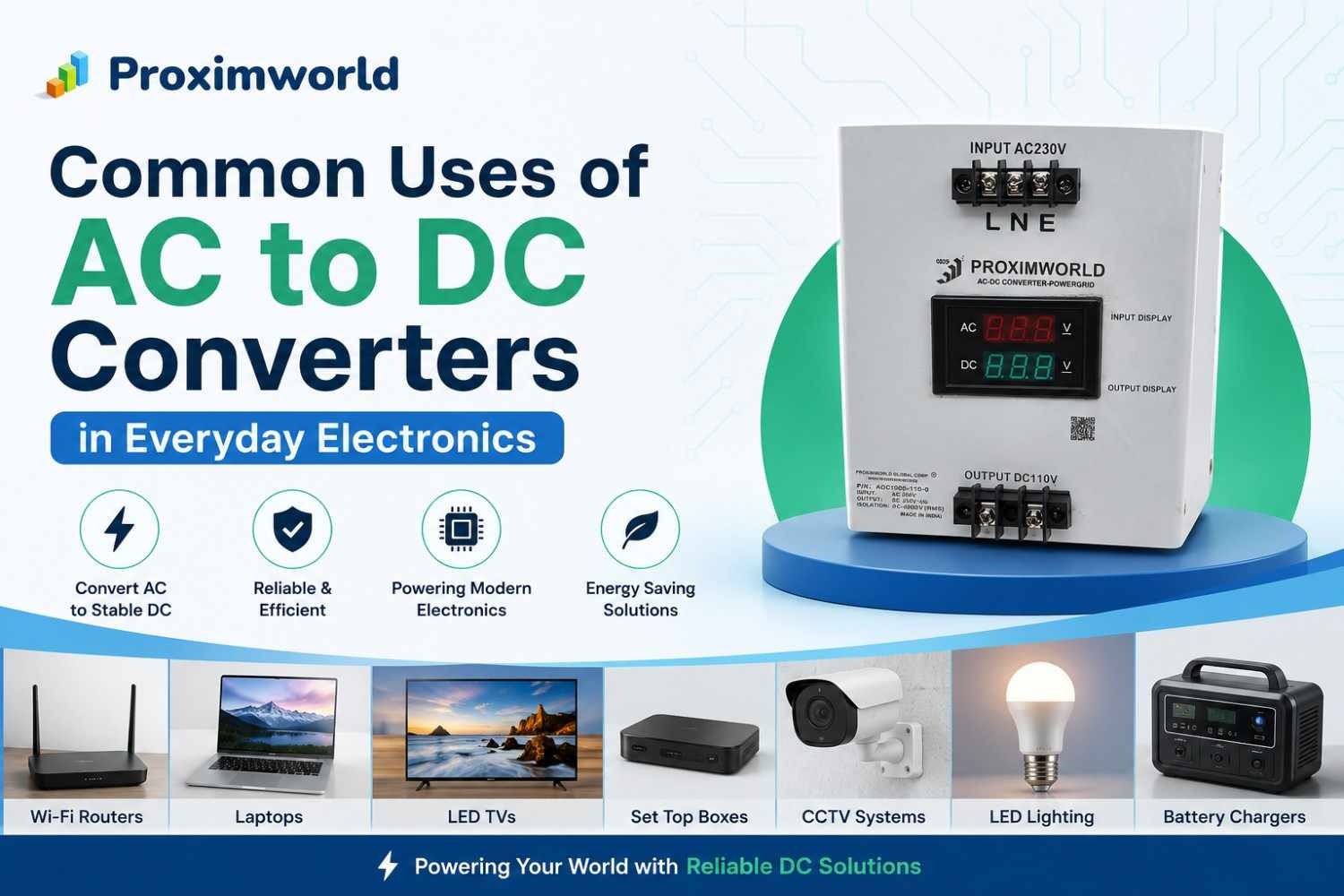
From the smartphone on your desk to the industrial machinery on a factory floor, virtually every piece of modern electronics relies on one foundational component: an AC to DC converter. These compact yet powerful devices silently convert the alternating current (AC) that flows from wall outlets into the smooth, stable direct current (DC) that electronics actually need to function.
Despite being one of the most ubiquitous components in the electronics world, AC to DC converters are often overlooked. Most people never think twice about the brick-shaped adapter sitting behind their laptop or the power supply humming inside their desktop computer — but without these converters, our digital world simply would not work.
In this guide, we explore what an AC to DC converter is, how it works, where it is used across everyday life, and what to look for when selecting the right one for your application.
An AC to DC converter — also called a rectifier, power adapter, or power supply unit — is an electronic device that transforms alternating current into direct current. Alternating current periodically reverses direction, which makes it ideal for long-distance power transmission through the electrical grid. Direct current flows in one constant direction, making it the standard power format for virtually all electronic circuits, components, and digital devices.
According to the International Energy Agency (IEA), power supplies and converters collectively account for over 10% of global electricity consumption in residential and commercial settings, underscoring just how central these devices are to everyday energy infrastructure.
Most consumer electronics operate on DC voltages ranging from 1.5V to 48V, while standard wall outlets in most countries supply AC at 110V or 230V. The AC to DC converter bridges this essential gap.
Understanding the internal process of an AC to DC converter helps clarify why it is so essential. The conversion process typically involves four key stages:
A transformer steps the incoming AC voltage up or down to the required level.
Diodes convert the AC waveform into a pulsating DC signal by allowing current to flow in only one direction.
Capacitors and inductors smooth the pulsating DC into a more stable, continuous voltage.
Voltage regulators maintain a consistent output voltage even when the input or load conditions fluctuate.
The result is a clean, regulated DC voltage supply that is safe and stable enough to power sensitive electronic components.
The applications of an AC to DC converter span virtually every sector of modern life. From consumer gadgets and industrial automation to healthcare equipment and renewable energy systems, these converters are essential for delivering stable DC power.
Almost every electronic device found in homes depends on AC to DC conversion.
Industrial systems require reliable DC power for automation and control.
Communication infrastructure relies heavily on efficient power conversion.
AC to DC converters play a critical role in modern energy infrastructure.
Medical devices require highly stable and noise-free DC power.
Modern vehicles and transportation systems increasingly depend on AC to DC conversion.
As industries adopt automation, renewable energy, and electric mobility, the demand for efficient AC to DC converters continues to grow. These devices remain one of the most critical building blocks of modern electronic systems.
The growing adoption of automation, renewable energy, and electric vehicles
continues to increase global demand for high-efficiency AC to DC converter solutions.
Not all converters are the same. The right type depends entirely on the application’s requirements for efficiency, size, cost, and output precision.
| Converter Type | Key Feature | Typical Use | Efficiency |
|---|---|---|---|
| Linear Power Supply | Low noise output | Lab equipment, audio | 30–60% |
| SMPS (Switched-Mode) | High efficiency, compact | Computers, chargers | 80–95% |
| Half-Wave Rectifier | Simple, low cost | Basic circuits | Low |
| Full-Wave Rectifier | Better ripple performance | Power supplies | Moderate |
| PFC Converter | High power factor, clean input | Industrial, data centres | 90–98% |
Investing in a high-quality AC to DC converter brings measurable advantages across every application:
Regulated converters maintain consistent output voltage regardless of input fluctuations, protecting sensitive electronics from damage.
Modern SMPS designs achieve efficiencies of up to 95%, reducing energy costs and heat generation significantly.
Switched-mode converters are significantly smaller and lighter than older linear designs, making them ideal for space-constrained applications.
Many universal AC to DC converters accept input from 85V to 264V AC, making them suitable for global use without manual voltage switching.
Quality converters carry CE, UL, or RoHS certifications, ensuring they meet international safety and environmental compliance standards.
Built-in overcurrent, overvoltage, and short-circuit protection prevent damage to both the converter and the connected load.
Selecting the correct power converter is critical to system reliability and efficiency. Here are the most important parameters to evaluate:
When evaluating options, consider partnering with a specialist supplier who can guide your selection based on your specific application requirements. Explore the range of AC to DC converters available to find the right match for your needs.
“The single most common cause of premature electronics failure in industrial environments is inadequate power conditioning. Choosing an AC to DC converter with proper protection features and appropriate thermal ratings is not an area where engineers should compromise. The converter is the foundation of every system.”
— Power Electronics Engineering Perspective
Browse our comprehensive range of industrial and commercial power converters — from compact DIN rail models to high-power open-frame units, designed for every sector and application.
The AC to DC converter is one of the most foundational components in the world of electronics — present in nearly every device that draws power from a wall outlet, from a simple phone charger to a complex industrial control system. Understanding where and how these converters are used is the first step toward making informed decisions when designing, specifying, or procuring power systems.
As technology advances and energy efficiency standards become more demanding, the design and performance of AC to DC converters continue to evolve. Modern switch-mode power supplies now achieve efficiencies that would have been extraordinary a decade ago, and new topologies such as GaN (gallium nitride) and SiC (silicon carbide) power devices promise even greater performance gains in the coming years.
Whether you are an engineer designing a new system, a procurement professional sourcing components, or simply someone curious about the technology powering your everyday devices, choosing the right power conversion solution matters. Explore our full selection of AC to DC converters to find the optimal solution for your specific requirements.

Leave a comment