
No products in the cart.

Standardize your battery bank and wiring at 24V, then feed 12V-rated displays, radios, sensors, and
lighting from the same system — without a second power chain. That’s the entire job of a
24V to 12V DC-DC converter, and getting the spec wrong is one of the most common (and
most expensive) mistakes in industrial and mobility power design. This guide covers exactly how these
converters work, where they’re used, which specifications actually matter, and how to pick one that
survives in the field instead of failing six months after commissioning.
What Is a 24V to 12V DC-DC Converter?
A 24V to 12V DC-DC converter is a power electronics module that takes a nominal 24V DC input — typically
from a battery bank, industrial power bus, vehicle electrical system, or an AC to DC power supply feeding a 24V rail — and steps it down to a regulated 12V DC output. Unlike a simple resistive divider, it does this using active switching electronics, so the output stays stable even as the input voltage sags under load or fluctuates with battery charge state.
These converters are sized by wattage (or output current at 12V) and supplied as chassis-mount, DIN-rail-mount, or PCB-mount modules depending on where they sit in the system. Proximworld’s own
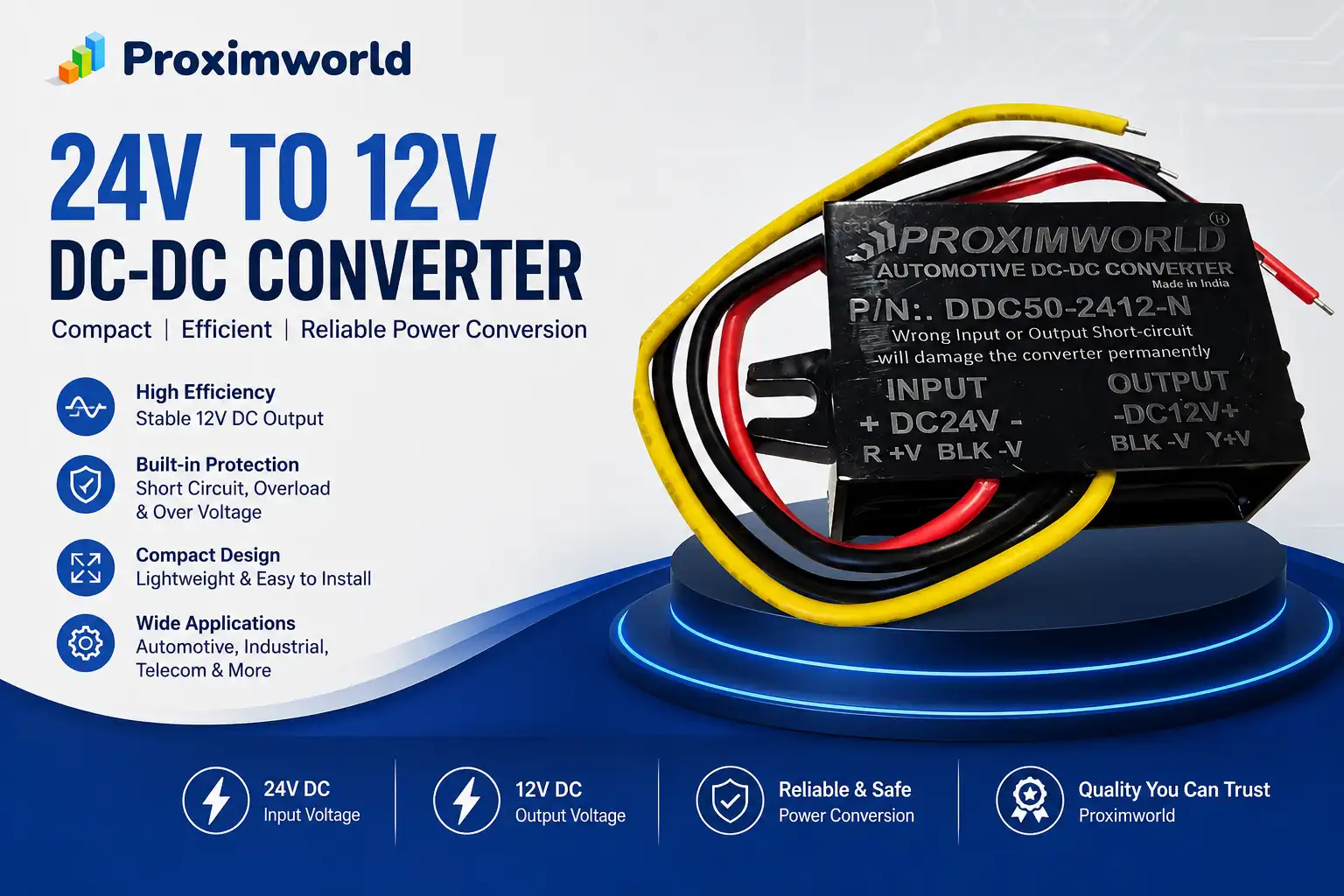
24VDC to 12VDC 1~10A DC-DC converter is a practical example: a 24V-input module delivering up to roughly 10A at 12V, used across industrial and telecom retrofit projects where a 24V system needs to feed 12V accessories.
How a 24V to 12V DC-DC Converter Works
Most modern 24V to 12V converters use a switch-mode topology — typically a buck (step-down) converter
for non-isolated designs, or a flyback/forward converter when galvanic isolation is required. The basic
operating sequence:
- Input conditioning — incoming 24V DC passes through EMI filtering and reverse-polarity/surge protection before reaching the switching stage.
- High-frequency switching — a MOSFET switches the input voltage on and off at a high frequency (commonly tens to a few hundred kHz), chopping the DC into a pulse train.
- Energy storage and transfer — an inductor (non-isolated) or a high-frequency transformer (isolated) stores and transfers energy during each switching cycle, stepping the voltage down.
- Rectification and filtering — the output is rectified and smoothed through an output capacitor bank to produce clean, low-ripple 12V DC.
- Feedback regulation — a control loop continuously monitors the output voltage and adjusts the switching duty cycle, keeping the 12V output stable despite input swings or changing load current.
Because conversion happens through switching rather than dissipating excess voltage as heat, these
converters run cool and efficient even at meaningful load currents — a major reason they’ve replaced
linear regulators and dropping resistors in most industrial 24V-to-12V applications.
Benefits of Using a 24V to 12V DC-DC Converter
- Stable 12V output regardless of fluctuations on the 24V input bus, including voltage sag under battery discharge.
- Higher efficiency than linear regulation, reducing heat generation and the need for large heatsinks.
- Compact form factor that fits into control panels, enclosures, and vehicle compartments with limited space.
- Built-in protection — quality units include over-voltage, over-current, over-temperature, and short-circuit protection, reducing the risk of downstream equipment damage.
- System flexibility — lets designers standardize on a single 24V backbone (batteries, wiring, chargers) while still supporting legacy or third-party 12V devices.
- Isolation option — where required, isolated designs add galvanic separation, protecting sensitive electronics from ground loops and voltage transients.
Key Applications & Industries
A 24V to 12V DC-DC converter is rarely a standalone product decision — it’s usually one component in a
larger power architecture. The most common use cases:
Telecom Infrastructure
Telecom sites commonly run 24V or 48V DC power plants for reliability, while radios, monitoring units,
and networking gear are often 12V-rated. A dedicated converter lets operators standardize battery
backup and rectifier infrastructure at 24V while still supporting 12V equipment without a separate
power chain.
Railway Systems
Rolling stock and trackside equipment frequently operate on 24V (or higher) onboard supplies. Interior
lighting, driver console displays, communication equipment, and auxiliary control circuits often need a
regulated 12V feed, making isolated, vibration-rated DC-DC converters a standard part of railway
electronics design.
Electric Vehicles (EV) & Automotive
In EVs and commercial vehicles with 24V electrical architectures, a 24V to 12V converter powers legacy
12V accessories — infotainment, auxiliary lighting, sensors, and communication modules — without
requiring a full redesign of the vehicle’s low-voltage harness.
Industrial Automation & Control Panels
PLCs, sensors, relays, and HMIs in industrial panels are sometimes specified at 12V even when the
plant’s control power distribution runs at 24V. A converter allows integrators to bridge these voltage
domains within the same enclosure.
Marine & Defence Systems
Marine and defence-grade platforms often standardize on 24V battery banks for onboard equipment, while
navigation, communication, and lighting subsystems may require regulated 12V — making ruggedized
converters with wide input tolerance and surge protection essential.
Important Specifications to Check
Before selecting a converter, engineers and buyers should review these core
specifications:
- Input voltage range — the tolerance band around nominal 24V (accounting for battery charge/discharge swings).
- Output current / wattage rating — must comfortably cover peak load, not just average load.
- Isolation rating — isolated vs. non-isolated, and the isolation voltage if applicable.
- Efficiency — higher efficiency reduces heat and improves reliability, especially in sealed enclosures.
- Protection features — over-voltage, over-current, over-temperature, and short-circuit protection.
- Operating temperature range — critical for outdoor telecom, railway, and defence installations.
- Mounting format — chassis mount, DIN-rail mount, or PCB mount, depending on the installation.
- EMI/EMC compliance — relevant for systems with strict electromagnetic interference requirements, such as railway and defence.
- Ripple and noise — lower output ripple matters for sensitive downstream electronics like sensors and communication modules.
Sizing rule of thumb: size the converter to peak load, not average load, and leave
headroom — running a unit continuously at its rated ceiling shortens its service life and increases
the odds of nuisance shutdowns.
Isolated vs Non-Isolated 24V to 12V Converters
One of the most important decisions in specifying a 24V to 12V DC-DC converter is whether the
application needs galvanic isolation between input and output.
| Aspect | Isolated Converter | Non-Isolated Converter |
|---|---|---|
| Electrical Connection | Input and output are galvanically separated, usually via a transformer | Input and output share a common ground reference |
| Protection | Protects downstream equipment from ground loops, voltage spikes, and noise | Offers less protection against transients on the source side |
| Efficiency | Slightly lower due to transformer losses | Generally higher efficiency for the same power level |
| Size & Cost | Larger and typically more expensive due to transformer and safety spacing | More compact and cost-effective |
| Best Suited For | Railway, telecom, defence, marine — environments with unstable grounds or safety isolation requirements |
Automotive accessories, point-of-load conversion within a single grounded system |
How to Choose the Right 24V to 12V DC-DC Converter
- Define the real load profile. Calculate peak current draw, not just steady-state, and size the converter with margin rather than running it at its rated ceiling continuously.
- Confirm the input voltage window. A battery-fed 24V system may realistically swing between roughly 21V and 29V depending on charge state — the converter’s input range must cover this
comfortably. - Decide on isolation early. If the downstream circuit shares a chassis ground with noisy equipment, or the application is railway, telecom, or defence-grade, isolation is usually the
safer default. - Match the mounting format to the enclosure. Chassis-mount and DIN-rail options simplify integration into control panels, while PCB-mount units suit embedded designs.
- Check environmental ratings. Operating temperature range, ingress protection, and vibration tolerance matter for outdoor, vehicle, or shipboard installations.
- Look for built-in protections. Over-voltage, over-current, short-circuit, and thermal protection reduce field failures and protect connected equipment.
- Verify certifications and documentation. Especially for regulated sectors like railway and defence, ask the supplier for compliance documentation relevant to your application.
Common Mistakes to Avoid
- Sizing only for average load. Inrush and peak currents can be significantly higher than steady-state draw, leading to nuisance shutdowns or premature failure.
- Ignoring input voltage variation. A converter rated tightly around 24V may fail to regulate properly once the battery bank discharges toward its lower limit.
- Skipping isolation when the application needs it. Using a non-isolated converter in a system with unstable grounding can introduce noise or damage sensitive downstream electronics.
- Overlooking thermal derating. Running a converter near its maximum rated output in a hot, poorly ventilated enclosure shortens its service life considerably.
- Choosing based on price alone. A converter without proper protection circuitry may be cheaper upfront but far costlier after a field failure damages connected equipment.
- Not confirming mounting compatibility. Retrofitting the wrong mounting format into an existing panel often causes unnecessary rework.
Proximworld’s 24V to 12V Converter Solutions
Proximworld Global Corp supplies industrial-grade DC-DC converters, AC-DC power supplies, and battery
charging solutions for telecom, railway, EV, marine, defence, solar, and industrial automation. Within the DC-DC range, the 24VDC to 12VDC 1~10A DC-DC converter is built specifically for 24V systems that need a regulated 12V feed for accessories, communication equipment, or control electronics.
Working on a different voltage pair? Browse the full DC to DC converter product line — including options for 48V-based systems — or read the companion 48VDC to 12VDC 10A converter guide if your system runs on a 48V bus instead.
Not sure which converter fits your system?
Tell us your load profile, isolation needs, and environment
we’ll help you spec it right the first time.
Conclusion
A 24V to 12V DC-DC converter is a small component with an outsized impact on system reliability.
Getting the specification right — input range, current capacity, isolation, protection features, and
environmental rating — determines whether a power architecture runs trouble-free for years or becomes a
recurring maintenance issue. Whether you’re designing a telecom power plant, a railway control panel,
an EV auxiliary circuit, or an industrial enclosure, matching the converter to the actual electrical and
environmental conditions of the application is the single most important step in the selection process.
Frequently Asked Questions
What is a 24V to 12V DC-DC converter used for?
It steps down a 24V DC supply to a regulated 12V DC output, allowing 12V-rated equipment such as displays, radios, sensors, and lighting to operate safely from a 24V power bus or battery bank.
Is a 24V to 12V converter the same as a voltage regulator?
Not exactly. A basic linear regulator dissipates excess voltage as heat and is inefficient at higher currents, while a DC-DC converter uses switch-mode conversion to step down voltage efficiently, with far less heat generation.
Do I need an isolated or non-isolated 24V to 12V converter?
Isolated converters are generally recommended for railway, telecom, marine, and defence applications where ground loops or electrical noise are a concern. Non-isolated converters suit simpler, single-ground systems such as automotive accessory circuits.
How do I size a 24V to 12V DC-DC converter for my application?
Calculate the peak current draw of all connected 12V loads, then choose a converter with rated output current comfortably above that peak, rather than sizing only for average load.
Can a 24V to 12V converter handle battery voltage fluctuations?
A properly specified converter is designed with an input voltage range that covers typical battery swings, from a discharged state to a fully charged or charging condition, so the 12V output stays regulated throughout.
What protection features should a good 24V to 12V converter have?
Look for over-voltage protection, over-current protection, short-circuit protection, and over temperature protection, as these reduce the risk of damage to both the converter and the connected equipment.
Are 24V to 12V DC-DC converters suitable for railway applications?
Yes, provided the unit is rated for the vibration, temperature range, and EMI requirements typical of railway environments. Isolated designs are commonly preferred for this sector.
What mounting options are available for these converters?
Common formats include chassis mount, DIN-rail mount, and PCB mount, chosen based on how the converter will be integrated into a panel, enclosure, or embedded circuit board.
Why does efficiency matter in a DC-DC converter?
Higher efficiency means less energy is lost as heat during conversion, which reduces thermal stress on components, extends operational life, and can reduce the need for additional cooling.
Can 24V to 12V converters be used in EV auxiliary systems?
Yes. In vehicles with a 24V electrical architecture, these converters commonly power 12V-rated accessories such as infotainment units, auxiliary lighting, and sensor modules without redesigning the vehicle’s low-voltage wiring.

Leave a comment