
No products in the cart.

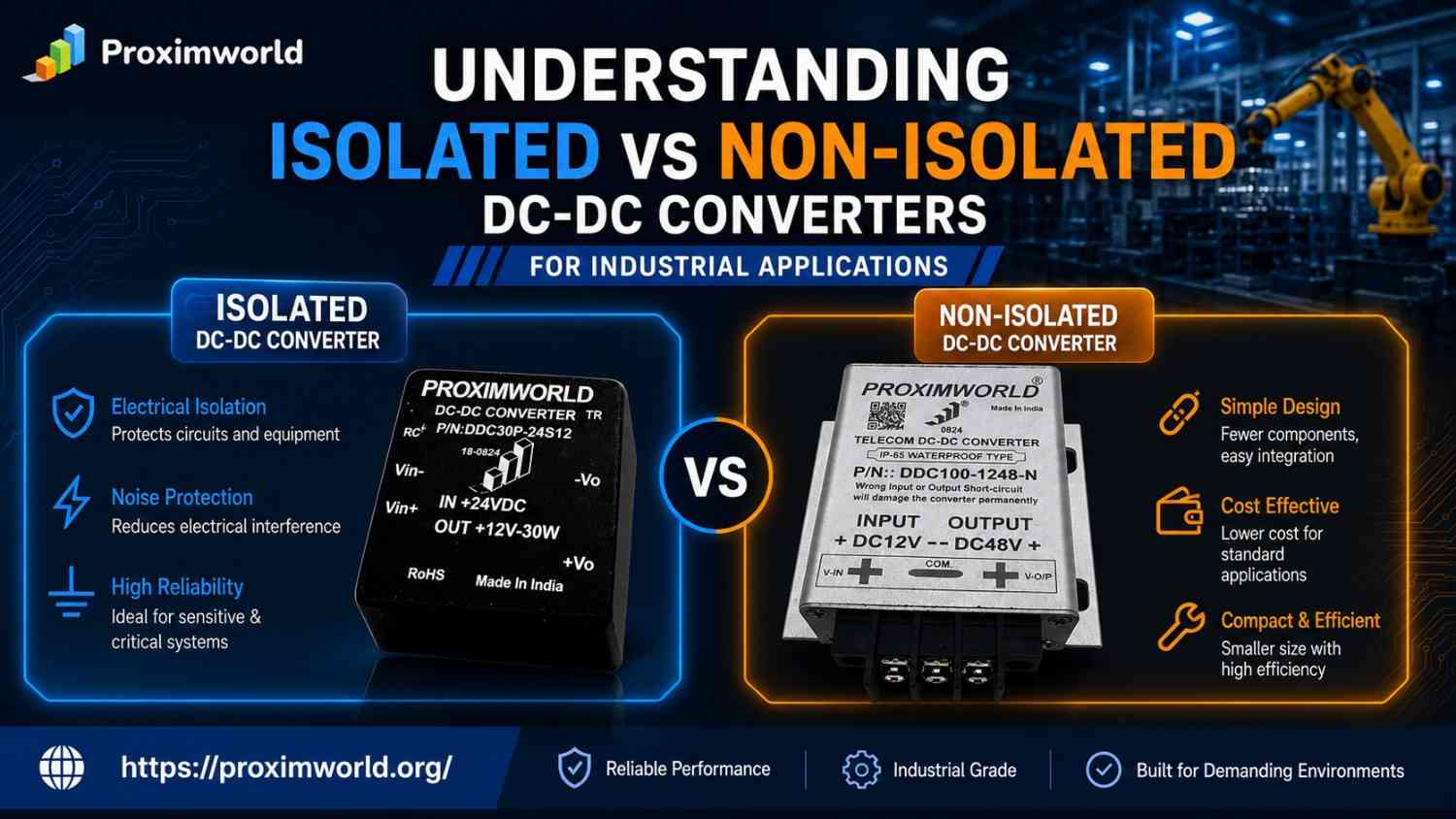
In today’s demanding industrial landscape, reliable and efficient voltage conversion is the backbone of nearly every automated system, control panel, and field device. Whether you are powering a PLC in a manufacturing plant, a sensor node on a remote pipeline, or a communication gateway in a smart factory, the humble DC-DC converter sitting on your board makes a critical difference to safety, efficiency, and total cost of ownership.
Yet one of the most consequential — and frequently misunderstood — decisions in power electronics design is deceptively simple in its framing: should I use an isolated or a non-isolated DC-DC converter? The wrong answer can cause ground-loop noise, regulatory non-compliance, premature component failure, or even safety hazards for personnel.
This guide unpacks both converter families from the ground up, explores their industrial applications, compares their real-world trade-offs, and helps you make a confident, engineering-sound decision. If you are sourcing components, browse ProximWorld’s DC-to-DC converter range — one of India’s most comprehensive catalogues for industrial power electronics.
An isolated converter uses a high-frequency transformer to transfer power magnetically from the input stage to the output stage. Because energy crosses an insulating barrier — not a copper conductor — there is no direct electrical (galvanic) path between input and output. Each side maintains its own independent ground reference, which is the fundamental source of all the safety and noise benefits isolation provides.
A non-isolated converter — typically a buck, boost, or buck-boost topology — uses an inductor to store and release energy. Input and output share a common ground, so current can flow directly between both sides. Without a transformer, these designs are inherently more compact, lighter, and highly efficient, making them the workhorses of distributed DC power supply rails inside an already-safe enclosure.
Key concept: Galvanic isolation means zero metallic conduction path between the input and output circuits. Power is transferred purely via electromagnetic fields through the transformer core — a wall that electricity cannot directly cross.
Electrical Safety
Prevents electric shock hazards in high-voltage industrial and medical environments.
Ground Loop Elimination
Independent grounds prevent hum, interference, and data corruption in sensor networks.
Voltage Flexibility
Easily achieves large step-up or step-down ratios — even polarity inversion.
Regulatory Compliance
Meets IEC/EN safety standards for medical, hazardous-location, and industrial certifications.
High Efficiency
Typical efficiency of 90–98%, minimising heat and power losses in always-on systems.
Compact Footprint
No transformer means smaller boards, higher power density, and lighter assemblies.
Cost Effectiveness
Fewer components and no transformer dramatically lower BOM and assembly costs.
Simpler Design
Fewer passive components shortens design cycles and eases EMC testing for on-board rails.
The choice between isolated and non-isolated topologies is rarely academic — it is driven by the actual electrical environment, safety requirements, and system architecture of the target application. Here is where each type delivers its best value in industrial electronics.
Isolated topologies include flyback (most common in low to medium power), forward, half-bridge, full-bridge, and push-pull converters. Each uses a transformer whose turns ratio defines the nominal input-to-output voltage conversion ratio. Flyback converters dominate the sub-30 W segment due to their simplicity; full-bridge designs handle multi-kilowatt industrial power supplies.
Non-isolated topologies come in three fundamental forms. The buck converter steps voltage down; the boost converter steps voltage up; and the buck-boost (or SEPIC/Ćuk) can do either. All three store energy in an inductor during the switch-on phase and release it during the switch-off phase. Their efficiency advantage over isolated topologies stems directly from avoiding transformer core and winding losses.
A common misconception is that isolation automatically equals low noise. While isolation eliminates conducted noise paths between grounds, the high switching frequencies used in isolated converters — combined with the large dV/dt across primary-side switches — can generate significant electromagnetic interference (EMI). High-performance isolated modules often include an internal Faraday shield between primary and secondary windings to intercept capacitively coupled high-frequency noise. Common-mode and differential-mode filters are frequently necessary additions.
Non-isolated converters, switching at very high frequencies (often 500 kHz–3 MHz in modern designs), require careful inductor selection and input/output capacitor placement to keep ripple within system limits. However, because both sides share a common ground, conducted EMI compliance is generally more straightforward.
Use this quick reference when evaluating which type of DC-DC converter to specify for your next industrial design.
| Parameter | Isolated | Non-Isolated |
|---|---|---|
| Galvanic Isolation | ✔ Yes (transformer) | ✘ No (shared ground) |
| Typical Efficiency | 75 – 90 % | 90 – 98 % |
| Size & Weight | Larger (transformer) | Compact & light |
| Cost | Higher BOM | Lower BOM |
| Safety Compliance | IEC, UL, medical ready | System-level isolation needed |
| Voltage Conversion Ratio | Wide range, any polarity | Limited (usually ≤ 10:1) |
| Ground Loop Risk | Eliminated | Present — must manage |
| Design Complexity | Moderate–High | Low–Moderate |
| Best For | Motor drives, comms interfaces, hazardous areas, medical | PoL regulation, internal bus conversion, automotive |
The isolated vs non-isolated decision is ultimately an architectural one that begins with a single question: does your system require a galvanic barrier between power source and load? If the answer is yes — due to safety regulations, ground management between subsystems, or protection of sensitive signal circuits — an isolated DC-DC converter is not optional. If your design operates entirely within a single, well-controlled ground domain and your priority is efficiency and board real estate, a non-isolated topology will serve you better.
In many modern industrial electronics architectures, the answer is both. A robust isolated front-end converter establishes a safe, clean intermediate bus, while a cascade of efficient non-isolated point-of-load converters distribute precisely regulated DC power supply rails to every subsystem. This combination exploits the strengths of each topology while mitigating their individual weaknesses.
Whatever your power conversion challenge, having access to quality components from a trusted supplier makes all the difference. ProximWorld is a premier destination for engineers and procurement teams sourcing reliable, certified power electronics in India — from compact isolated modules to high-efficiency synchronous buck regulators. Explore the full range and request technical support to match the right converter to your exact operating conditions.
Browse ProximWorld’s extensive catalogue of isolated and non-isolated DC-DC converters — from 1 W SIP modules to multi-output industrial brick converters, all sourced from leading global manufacturers.

Leave a comment