
No products in the cart.

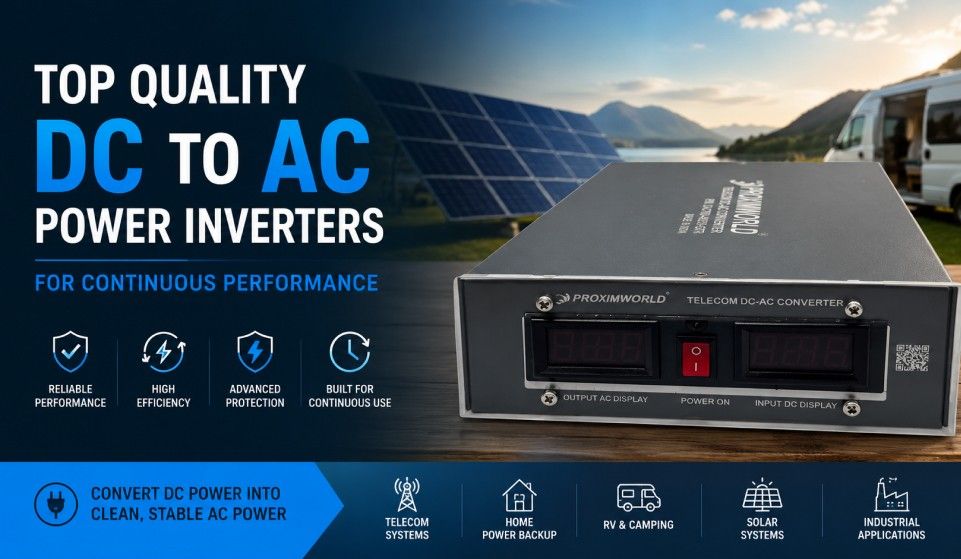
Whether you’re powering industrial equipment in the field, running sensitive electronics off-grid, or building a resilient backup power system, choosing the right DC to AC power inverter can make or break your operation. These devices sit at the heart of modern power electronics — converting stored or generated DC energy into the AC electricity that the vast majority of appliances and machinery demand. At ProximWorld, we supply precision-engineered inverters built for professionals who cannot afford downtime. This guide breaks down everything you need to know before choosing one.
A DC to AC power inverter is an electronic device that transforms direct current (DC) — typically sourced from batteries, solar panels, or a DC power supply — into alternating current (AC) suitable for powering standard electrical loads. This process of voltage conversion involves sophisticated switching circuits, pulse-width modulation (PWM) or sine-wave synthesis, and output filtering stages to deliver clean, stable power.
The best inverters maintain efficiency above 90% across their load range, minimise total harmonic distortion (THD), and incorporate multiple protection mechanisms — making them indispensable across sectors from telecommunications to renewable energy storage. Explore the full range of DC to AC converters at ProximWorld to find the specification that matches your load demands.
Premium inverters maintain 92–97% conversion efficiency even under variable loads, drastically reducing energy waste and heat generation across extended run times.
Over-voltage, under-voltage, short-circuit, over-temperature, and reverse-polarity protections ensure both the inverter and connected loads remain safe under fault conditions.
Pure sine wave models deliver THD below 3%, making them compatible with sensitive electronics, medical equipment, variable-speed motors, and audio systems.
Wide input voltage ranges (12V–96V DC) and adjustable AC output let industrial operators standardise on a single inverter model across diverse machinery and infrastructure.
Aluminium enclosures, conformal-coated PCBs, and IP-rated variants withstand vibration, humidity, dust, and extreme temperature ranges typical in industrial electronics environments.
From compact 300W units for vehicle accessories to 10kW+ rack-mount systems for data centres, the right inverter scales with your power demand without requiring a complete system redesign.
At its core, a DC to AC inverter relies on high-speed semiconductor switches — typically MOSFETs or IGBTs — arranged in an H-bridge or full-bridge topology. The control circuitry fires these switches in a precise sequence to chop the DC input into a high-frequency square wave, which is then transformed and filtered into a smooth AC output. This is where the engineering quality of the DC-DC converters used in the front-end stage becomes critical: unstable DC bus voltage leads directly to output distortion.
Many high-performance inverters incorporate an internal DC-DC converter stage — often a boost converter — that elevates the battery voltage to the high DC bus voltage required for efficient inversion. This intermediate stage allows the system to accept a wide input range (e.g., 10.5V–15V for a 12V nominal system) while maintaining a stable, regulation-grade bus voltage. Understanding this topology is key when specifying inverters for lithium battery systems, where the discharge curve drops steeply at low state-of-charge.
DC to AC power inverters are deployed wherever portable, renewable, or stored DC energy must drive AC loads. Here are the primary sectors where inverter quality directly impacts operational outcomes:
Solar and wind installations depend on inverters to convert stored battery energy into household or facility AC power. Grid-tie and hybrid inverter configurations require precise voltage conversion and synchronisation with the utility frequency.
In industrial electronics, inverters power CNC machines, conveyor systems, pumps, and HVAC units. Industrial-grade units must handle surge currents of 200–300% rated capacity during motor start-up — a common failure point for budget alternatives.
Telecom base stations, data centres, and emergency systems rely on inverters as part of their UPS architecture. The DC power supply from rectifiers charges batteries that feed inverters during outages — demanding zero-transfer-time switching and hot-swap capability.
Vehicles, vessels, and mobile command units use compact inverters to run AC loads from their 12V or 24V DC power supply. Marine-rated units add corrosion-resistant coatings and vibration-dampened mounting for harsh sea environments.
Medical-grade inverters power diagnostic equipment, imaging systems, and laboratory instruments that demand extremely low noise, stable frequency, and isolation from the DC power supply source to prevent ground-loop interference.
The choice between pure sine wave and modified sine wave inverters is often the most consequential specification decision. Here is a direct comparison to guide your selection:
| Parameter | Pure Sine Wave | Modified Sine Wave |
|---|---|---|
| Output Waveform | Smooth sinusoid | Stepped approximation |
| Total Harmonic Distortion | < 3% | 15–25% |
| Motor Compatibility | Excellent | Poor (causes heating) |
| Sensitive Electronics | Fully compatible | Risk of malfunction |
| Typical Efficiency | 90–97% | 85–92% |
| Ideal Use Case | Industrial, medical, audio, HVAC | Simple resistive loads, lighting |
| Relative Cost | Higher — justified by performance | Lower upfront cost |
01
02
03
04
05
Selecting a high-quality DC to AC power inverter is a foundational decision that affects system efficiency, equipment longevity, and operational safety. The differences between a precision-engineered unit from a specialist power electronics supplier and a generic alternative are not marginal — they manifest in real-world efficiency losses, premature component failure, and compatibility issues that cost far more to rectify than the initial saving.
Whether your application demands robust industrial electronics for a factory floor, a clean-output inverter for sensitive medical instruments, or a high-efficiency unit for a solar energy system, the key parameters remain consistent: waveform quality, continuous power rating, input voltage range, protection features, and certified build quality.
For professionally curated, specification-grade inverters backed by knowledgeable technical support, visit ProximWorld — your trusted source for DC power supply solutions, DC-DC converters, and the full spectrum of power conversion components built for continuous, reliable performance.

Leave a comment