
No products in the cart.

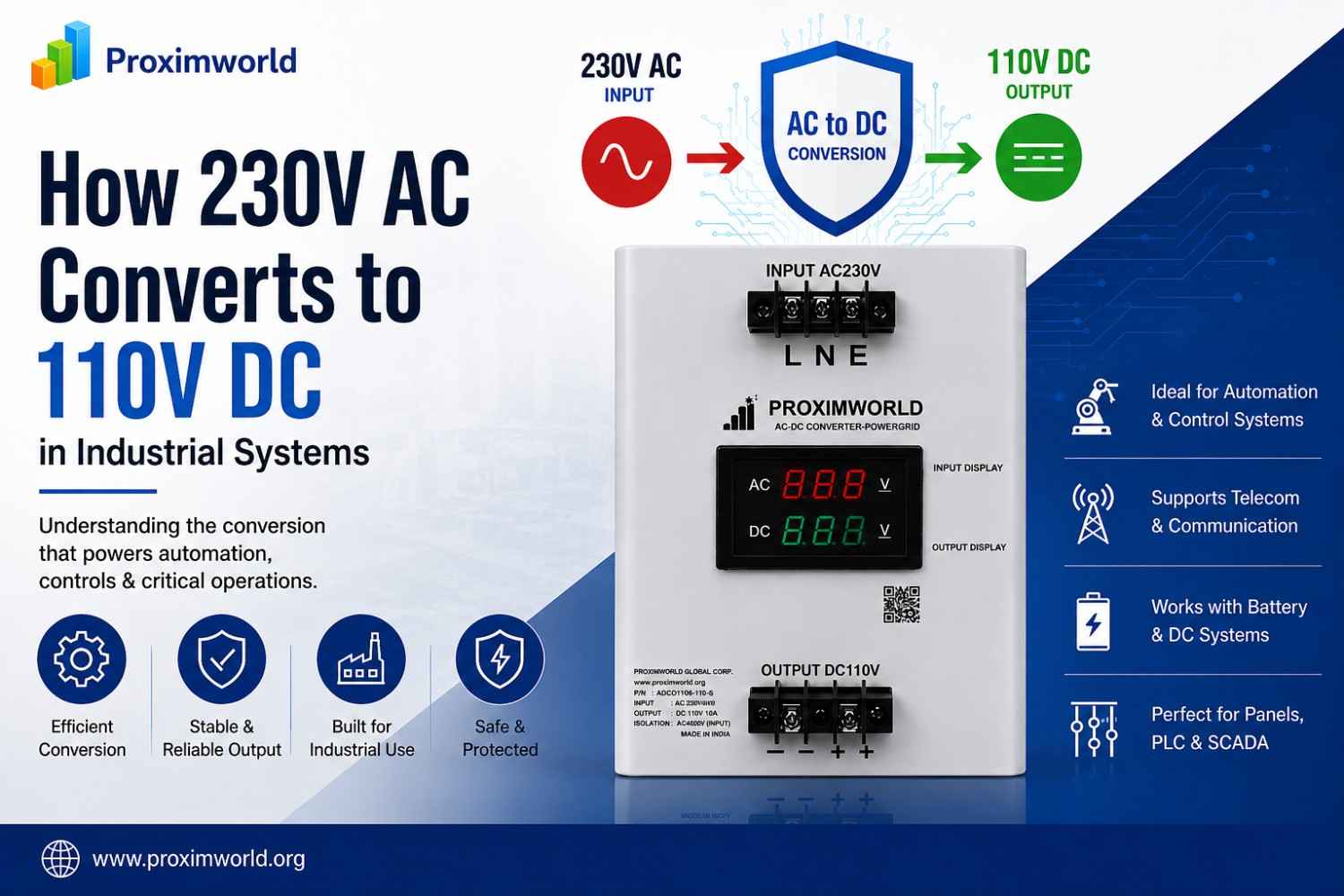
In modern industrial environments, reliable DC power is essential for operating automation systems, PLCs,
communication equipment, battery charging systems, and control panels. While most industrial facilities receive
standard 230V AC mains power from the grid, a vast array of critical applications require a highly stable 110V
DC output for safe, continuous, and efficient operation.
In many industrial sectors such as power generation, substations, and telecom infrastructure, 110V DC is widely
used because it provides reliable operation and integrates effectively with battery-backed DC systems.
An AC to DC Converter 230V to 110V DC
bridges this infrastructure gap by converting alternating current (AC) into regulated direct current (DC).
Unlike a simple transformer that merely steps down voltage, an industrial converter provides precision voltage
regulation, critical electrical isolation, and active protection features that safeguard sensitive equipment
from destructive grid fluctuations.
Whether you are upgrading an existing control system, designing a new automation panel, or replacing an aging
unit with modern industrial power supplies, selecting the right converter is non-negotiable for ensuring long-term operational efficiency.
This comprehensive AC to DC Converter Guide
explores exactly how these converters work, where they are deployed, how to calculate your power needs, and the
strict technical features required for industrial compliance.
An AC to DC converter, frequently referred to as a rectifier or an industrial power supply, is a sophisticated
electronic device designed to transform alternating current (AC) from a utility grid into a steady,
one-directional direct current (DC) output.
While consumer-grade adapters perform this task for laptops and phones, an industrial AC to DC Converter
230V to 110V DC is engineered for a completely different environment. These robust units are built
to operate continuously (24/7/365) in harsh conditions, enduring extreme temperatures, heavy vibrations, and
significant electrical noise without failing.
To understand the high-level engineering behind these units, we must look at the four distinct internal stages
that an industrial converter uses to transform volatile AC into clean DC.
The converter receives 230V AC single-phase power. High-quality units immediately pass this through an isolation transformer, which magnetically disconnects the internal circuitry from the main grid, preventing dangerous faults from crossing over.
A network of diodes (typically a bridge rectifier) acts as a series of one-way valves. They flip the negative half of the AC sine wave into a positive direction, creating a “pulsating” direct current.
While the current is now moving in one direction, it is still pulsating heavily. Large electrolytic capacitors act as energy reservoirs, filling in the gaps between pulses to “smooth” the wave into a relatively flat line.
Finally, electronic regulation circuits (often using high-frequency switching MOSFETs) lock the output at exactly 110V DC. This ensures that even if the factory’s input voltage drops to 200V or spikes to 250V, the output remains a perfectly stable 110V.
While consumer electronics run on 5V or 12V DC, and telecom systems traditionally use 48V DC, 110V
DC holds a special place in heavy industrial architecture. Why?
In massive facilities like power plants or steel mills, control cables may run for hundreds of meters. A 12V or 24V signal would suffer severe voltage drop over that distance, potentially failing to trigger a relay. 110V DC pushes through long wire runs with minimal loss.
While higher voltages like 220V DC can sustain dangerous electrical arcs across switch contacts, 110V DC strikes an optimal balance. It provides high power but is easier to extinguish using standard industrial switchgear.
Heavy industries rely on massive banks of lead-acid or NiCd batteries for emergency backup power. These banks are traditionally configured in 110V arrays (often utilizing about 90 to 92 individual cells). Using 110V DC control systems means the entire factory logic can run seamlessly on batteries during a blackout without needing complex inverters.
Why not just buy a cheap commercial power supply? Investing in a true industrial-grade converter provides
critical operational advantages:
Delivers clean, flat power that prevents erratic behavior, ghost signals, and logic faults in PLCs and sensors.
High Mean Time Between Failures (MTBF) ensures continuous production without catastrophic power supply failures.
Buffers sensitive microelectronics against harsh grid transients, brownouts, and voltage spikes.
Modern SMPS designs significantly reduce energy waste, lowering control cabinet cooling costs.
Specifically engineered with heavy-duty capacitors and heat sinks to run fully loaded around the clock, 365 days a year.
Advanced 4000V galvanic isolation protects human operators and adjacent machines from lethal grid faults.
If you are tempted to use a commercial power supply in an industrial setting, consider the fundamental
engineering differences:
| Feature | True Industrial Converter | Consumer / Commercial Adapter |
|---|---|---|
| Duty Cycle | 24/7/365 Continuous | Few Hours (Intermittent) |
| Cooling & Thermal | Active fans or massive aluminum heat sinks | Passive (plastic casing traps heat) |
| Electrical Isolation | High (Up to 4000V AC) | Low (Basic consumer safety limits) |
| Protection Circuits | OVP, OCP, SCP, OTP built-in | Often relies on a single internal fuse |
| Vibration Resistance | Epoxy-potted components, screw terminals | Solder-only joints prone to cracking |
Regulated 110V DC power is the lifeblood across multiple critical infrastructure sectors.
Powering heavy solenoids, CNC machine logic boards, and industrial automation products seamlessly without introducing AC hum.
Critical for providing switching power to high-voltage breakers. If the grid fails, the 110V DC battery banks take over instantly.
Functioning as a high-tier solution for battery charger solutions to manage float charging for massive emergency backup arrays.
Driving track circuit relays and safety interlocking systems securely over long geographic distances.
Sustaining legacy communication cabinets and specialized routing hardware.
Powering SCADA networks and RTU telemetry away from AC noise interference.
Purchasing the wrong power supply can result in catastrophic equipment failure. Follow this selection guide to ensure compatibility.
Ensure your control panel components strictly require 110V DC. Supplying 110V to a 24V PLC will instantly destroy it. Conversely, under-powering a 110V relay coil with 48V will result in a failure to actuate.
Look at your installation environment. Will the converter sit inside a sealed NEMA 4X cabinet in the summer heat? If so, you need a unit derated for high temperatures, or one featuring highly efficient active cooling fans to prevent thermal shutdown.
Select Panel Mount (screw-in chassis) for high-vibration machine frames, DIN Rail Mount for standard control cabinets, or Rack Mount for IT and telecom server integration.
When reviewing specification sheets, prioritize these non-negotiable features:
Magnetically separates the dangerous grid from your control circuits, preventing fatal voltage crossover.
Ensure the unit has Over-Voltage, Over-Current, Short-Circuit, and Over-Temperature protections built-in. It should recover automatically once the fault is removed.
Enhances passive heat dissipation and provides EMI (Electromagnetic Interference) shielding against nearby factory motors.
Spring clips fail under machine vibration. Heavy-duty screw terminals guarantee wires stay locked in place.
An AC to DC converter is a dedicated power supply that takes alternating current (AC) from
the utility grid and transforms it into a highly stable, direct current (DC) voltage required by modern
industrial automation systems, sensors, and control panels.
110V DC allows for highly stable control signaling over long cable distances without
voltage drop. It prevents relay chatter and enables seamless battery backup integration for mission-critical
infrastructure like substations.
Multiply the total current (in Amps) your devices will draw by the voltage (110V). Always
add a 20-30% headroom buffer to allow for startup surges and prevent thermal wear on the power supply.
Yes, genuine industrial power supplies, like those from Proximworld, are specifically
designed with heavy-duty components to run at 100% full load, 24 hours a day, 365 days a year without
failing.
Galvanic isolation uses an internal high-frequency transformer to magnetically separate
the high-voltage AC input from the DC output. This prevents grid transients and lightning strikes from
bypassing the power supply and destroying your sensitive electronics.
Yes, many industrial 110V DC converters can function perfectly as an industrial battery
charger for backup systems, provided they are configured with appropriate constant-current limiters to
prevent overcharging.
Absolutely. A regulated AC DC Converter for PLC ensures that logic controllers receive
perfectly clean, ripple-free power, eliminating logic faults, sensor errors, and dropped network
communications.
When properly sized (leaving 30% headroom) and installed in a well-ventilated, dry control
cabinet, a premium industrial SMPS converter provides many years of reliable service.
They are largely maintenance-free. Periodically clear dust from ventilation ports and
fans, and manually verify that screw terminals remain tightly secured against machine vibration.
They are heavily utilized in power generation, high-voltage electrical substations,
railway signaling, heavy manufacturing automation, telecom data centers, and petrochemical plants.
Choosing the correct AC to DC Converter is not simply about selecting the highest wattage. Understanding your
application’s voltage requirements, current demand, environmental conditions, protection features, and future
expansion plans ensures reliable long-term performance.
Whether you’re powering industrial automation systems, telecom equipment, substations, or laboratory instruments,
investing in a high-quality industrial converter improves safety, reduces downtime, and extends equipment life.

Leave a comment