
No products in the cart.

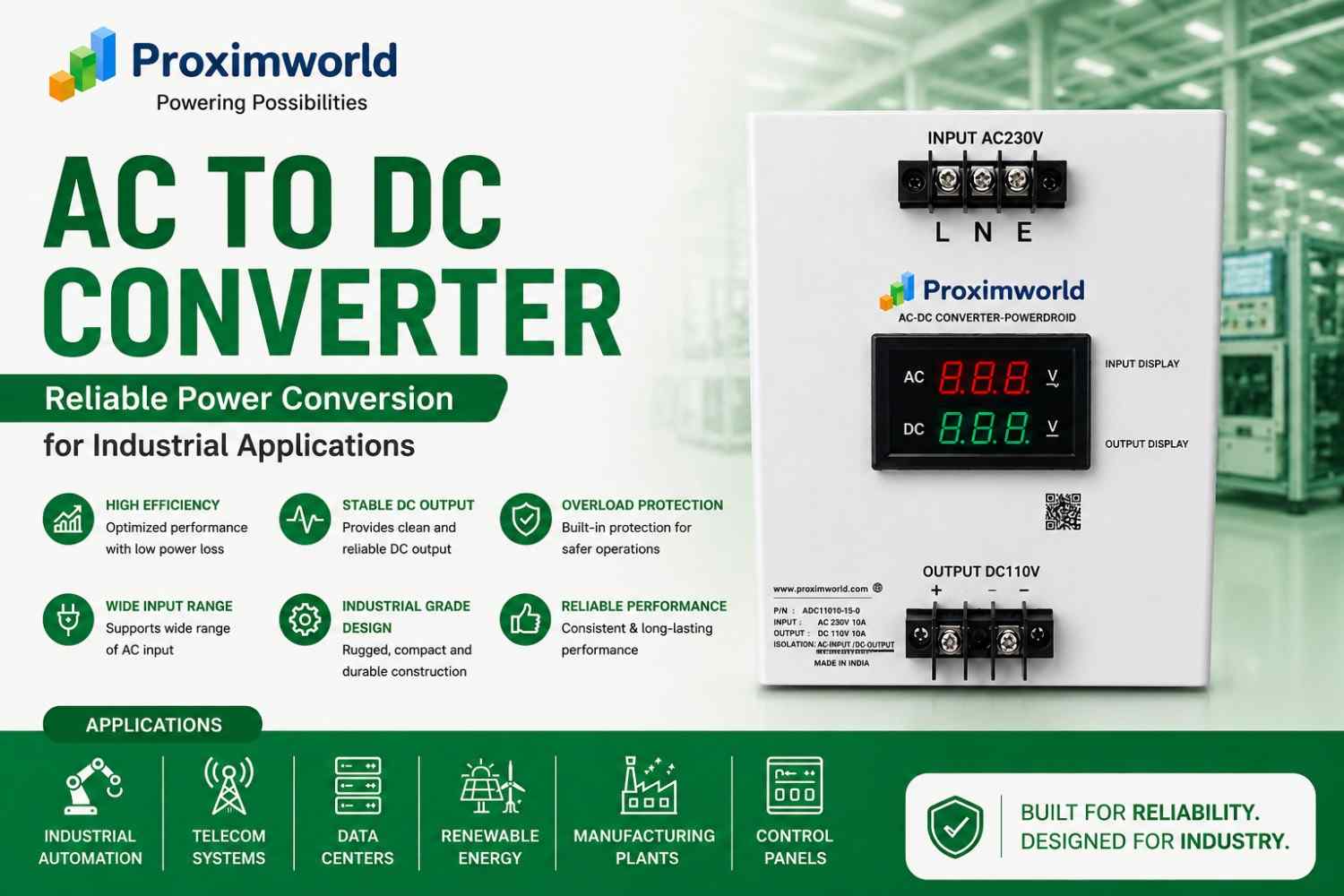
In virtually every industrial environment — from automated assembly lines and robotics to telecommunications infrastructure and medical devices — reliable, precisely regulated DC power is a non-negotiable requirement. An AC to DC converter is the critical power electronics device that takes alternating current (AC) from a mains supply and transforms it into stable, usable direct current (DC) power for these loads.
The conversion process involves rectification, filtering, and in modern switching designs, high-frequency transformation to maximize efficiency and minimize size. According to the International Energy Agency, power conversion accounts for roughly 10% of all global electricity consumption, which underscores why selecting a high-efficiency converter matters both operationally and financially.
This guide explores the leading industrial AC to DC converter solutions, breaks down the technology types, highlights real-world applications, and offers a practical buyer’s checklist to help engineers and procurement professionals make the right decision for their specific use case.
Not every power conversion solution is built the same. Industrial facilities face voltage fluctuations, high ambient temperatures, vibration, and demanding duty cycles that consumer-grade equipment simply cannot handle. Understanding the core converter types is the first step to matching the right technology to your application.
The most widely deployed type in industrial settings. SMPS converters operate at high frequencies (typically 20 kHz–2 MHz), delivering efficiencies above 85–95%, compact form factors, and wide input voltage ranges. Ideal for PLCs, HMIs, control panels, and distributed power architectures.
Linear regulators offer extremely low output noise and ripple, making them the preferred choice for sensitive instrumentation, audio equipment, and test and measurement environments. They are less efficient than SMPS but provide unmatched output purity where electromagnetic compatibility (EMC) is critical.
Purpose-built for industrial control cabinets, DIN rail mount converters snap directly onto standard 35 mm DIN rails. They offer easy installation, hot-swap capability in redundant configurations, and are designed to withstand the harsh thermal and vibration environments found in factory automation.
Heavy-duty rectifier systems are used in battery charging, electroplating, and high-current DC bus applications. These three-phase or single-phase bridge rectifier assemblies can deliver hundreds to thousands of amperes and are built for continuous 24/7 duty cycles.
When sourcing an AC to DC converter for industrial deployment, the specification sheet only tells part of the story. Here are the features that genuinely differentiate reliable industrial-grade units:
The demand for high-quality AC to DC converters spans nearly every industrial sector. Below are the primary application areas where the right power supply design is mission-critical.
Powers PLCs, servo drives, sensors, and HMI panels in 24 VDC control circuits across automated production lines.
Delivers regulated -48 VDC to telecom switching equipment, base stations, and data center power distribution units.
Powers imaging systems, patient monitors, and surgical equipment — requiring IEC 60601-1 compliant, low-leakage designs.
Onboard power supplies for trains, buses, and EVs must meet EN 50155 standards for shock, vibration, and wide temperature ranges.
Converts AC output from inverters and generators to stable DC for battery storage systems and off-grid power management.
Remote terminal units (RTUs) and field instruments in oil & gas, water treatment, and chemical plants depend on robust DIN rail power supplies.
Selecting the correct AC to DC power converter requires a structured approach. Follow this step-by-step evaluation framework:
Expert Insight: A common mistake is sizing a power supply at or near its rated capacity. Operating a converter at 50–70% of its rated load optimizes thermal performance and can extend operational life by 2–3× compared to running at 100% continuous load. This “conservative derating” principle is standard practice in industrial power system design.
The choice between a linear and switching AC to DC converter depends heavily on the application’s noise sensitivity, efficiency requirements, and size constraints. The table below provides a direct comparison:
Even the highest-specification AC to DC industrial power supply will underperform if not properly installed and maintained. Follow these best practices to maximize uptime and converter longevity:
Ensure adequate clearance around the unit for convection cooling (typically ≥50 mm on top and bottom for DIN rail units). In sealed enclosures, calculate heat load and size cooling accordingly. Avoid placing high-heat components adjacent to the power supply.
Always connect the PE (protective earth) terminal. Keep input and output wiring physically separated. Use shielded cables in EMI-sensitive environments and install line filters on the AC input when required by the application’s EMC standards.
Inspect and clean ventilation grilles quarterly. Check terminal torque values annually. Monitor output voltage drift over time — a deviation of more than ±2% from nominal can indicate aging capacitors and may warrant proactive replacement.
For high-availability systems, deploy two or more power supplies in parallel using approved redundancy modules. Test the failover function during scheduled maintenance windows. Document load capacity per unit and total system power budget.
Browse our curated selection of industrial-grade AC to DC converters — from compact DIN rail power supplies to high-current rectifier systems. Every product is tested, certified, and backed by expert technical support.
Choosing the right AC to DC converter for industrial applications is a decision that directly affects production uptime, energy efficiency, equipment longevity, and regulatory compliance. The market offers a wide spectrum of solutions — from compact DIN rail switching power supplies and precision linear regulators to robust three-phase rectifier systems — and the optimal choice is always application-specific.
By systematically evaluating your DC output needs, input supply characteristics, environmental conditions, certification requirements, and total cost of ownership, you can identify a converter that delivers reliable, efficient performance across the full lifecycle of your equipment.
Whether you are designing a new machine, upgrading a legacy control panel, or specifying power infrastructure for a large facility, Proximworld offers a comprehensive range of industrial AC to DC converters from trusted global manufacturers. Explore the catalog and connect with our technical team to find the best-fit solution for your power conversion challenges.
Everything you need to know about industrial AC to DC converter solutions.

Leave a comment