
No products in the cart.

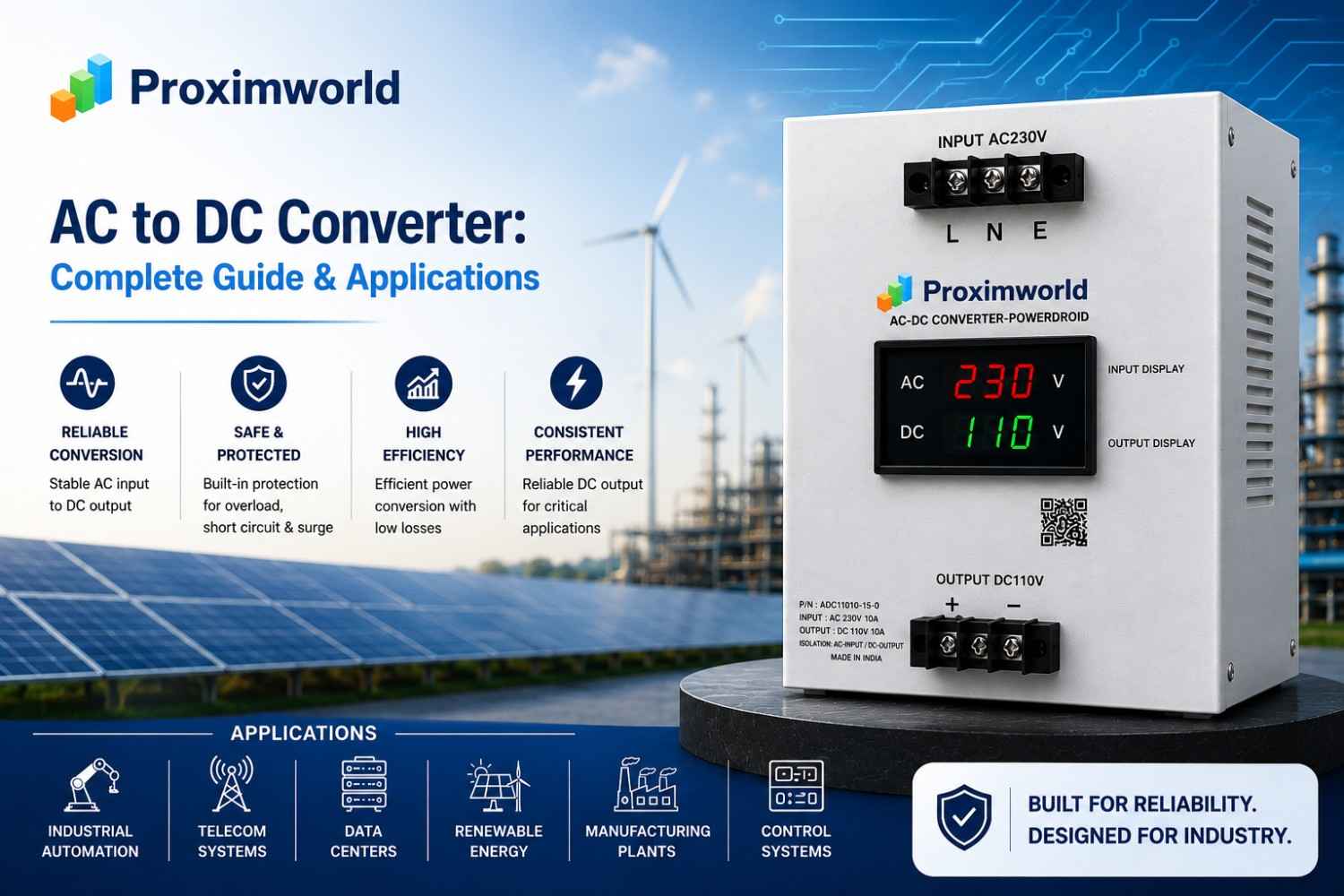
Almost every piece of modern electronic equipment, from the charger on your desk to the control panel on a factory floor, ultimately runs on direct current (DC). Yet the electricity supplied by power grids around the world is alternating current (AC).
Bridging this gap is the essential role of an AC to DC converter, a device that
transforms incoming AC voltage into stable, regulated DC power suitable for sensitive electronics, batteries, motors, and control systems.
As industries continue to expand their use of LED lighting, automation systems, telecommunications infrastructure, and electric vehicle charging networks, the demand for efficient, compact, and reliable AC-DC power conversion has grown significantly.
In this complete guide, we’ll explore how AC to DC converters work, the different types available, the features that separate a good converter from a poor one, real-world applications across industries, and practical guidance to help you select
the right AC to DC converter for your specific application.
An AC to DC converter is an electronic device that changes alternating current (AC), the type of electricity delivered through wall outlets and power grids, into direct current (DC), the steady, one-directional flow of electricity
required by most electronic components, batteries, LED drivers, and DC motors. Without this conversion step, devices such as smartphones, computers, industrial controllers, and security cameras simply could not operate safely from a standard AC
power source.
At its core, an AC to DC converter combines several stages of circuitry, including rectification, filtering, and voltage regulation, to take a fluctuating AC waveform and turn it into a clean, stable DC output. Depending on the design, output voltages
can range from a few volts for small electronics to several hundred volts for industrial machinery. Whether built as a small wall-mounted adapter, a DIN-rail mounted enclosure for control panels, or a high-capacity industrial power supply, the
underlying principle remains the same: deliver dependable DC power from an AC source.
Although designs vary by type and application, almost every AC to DC converter follows the same basic sequence of stages to transform raw AC power into usable DC output. Understanding this process makes it easier to evaluate converter specifications and
troubleshoot performance issues.
1
Alternating current enters the converter from the mains supply, typically at 110V-240V, depending on the region.
2
Diodes, often arranged in a bridge configuration, allow current to flow in only one direction, converting AC into pulsating DC.
3
Capacitors smooth out the pulsating DC signal, reducing ripple and producing a steadier voltage level.
4
A regulation circuit holds the output at a fixed voltage, compensating for changes in input voltage or load.
5
The final DC output is delivered to the connected load, such as a circuit board, battery, LED driver, or motor.
Not all AC to DC converters are built the same way. The right choice depends on factors such as required efficiency, output stability, size constraints, and budget. Below are the most common types used across consumer, commercial, and industrial applications.
The simplest and most affordable design, using a single diode to convert only one half of the AC waveform. It is low-cost but produces a less smooth output, making it suitable mainly for low-power, non-critical applications.
Uses both halves of the AC cycle, typically with a center-tapped transformer and two diodes, resulting in a smoother output and better efficiency than half-wave designs.
The most widely used rectifier configuration, using four diodes arranged in a bridge to convert both halves of the AC cycle without needing a center-tapped transformer. Common in most modern AC to DC converter products.
Provides a very clean, low-noise DC output, making it ideal for sensitive audio and laboratory equipment. However, linear designs are bulkier, heavier, and generate more heat due to lower efficiency.
The most popular choice for modern electronics. SMPS units rapidly switch the input power on and off, resulting in compact, lightweight, and highly efficient designs suitable for everything from chargers to industrial automation.
Not every converter on the market is built to the same standard. When evaluating an AC to DC converter,
the following features generally indicate a higher-quality, longer-lasting product:
Universal-input converters (typically 90V-264V AC) operate reliably across different countries and grid conditions.
Higher efficiency means less wasted energy as heat, lower operating costs, and reduced cooling requirements.
Overload, short-circuit, over-voltage, and over-temperature protection help prevent damage to both the converter and connected equipment.
Modern enclosures and DIN-rail mounted units allow easy integration into control panels and tight enclosures.
A clean, stable DC output protects sensitive components and extends the lifespan of connected devices.
Look for CE, UL, and RoHS markings, which indicate the converter meets recognized safety and environmental standards.
Investing in a quality AC to DC converter delivers measurable advantages across performance, safety, and cost. Some of the most significant benefits include:
AC to DC converters are foundational components across countless industries. Below are some of the most common real-world applications where reliable AC-DC power conversion is essential.
Powers base stations, routers, and network switches that must remain operational around the clock.
LED drivers rely on AC to DC converters to supply the precise, stable current LEDs need for consistent brightness and long life.
DIN-rail mounted converters power PLCs, sensors, actuators, and control panels in factories and production lines.
Diagnostic devices and monitoring equipment depend on medically certified converters for safe, isolated, and stable DC power.
High-power AC to DC conversion is central to fast-charging stations that supply DC power directly to electric vehicle batteries.
Chargers and power adapters for laptops, phones, and home appliances all rely on compact AC to DC converters.
Used in hybrid solar and battery backup setups to charge storage batteries directly from grid AC power when needed.
CCTV cameras, access control systems, and alarm panels require consistent DC voltage supplied by dedicated converters.
The table below offers a quick, side-by-side comparison of the three most commonly specified categories of AC to DC converters to help you understand the typical trade-offs between cost, size, and performance.
| Criteria | Linear Power Supply | Switch-Mode (SMPS) | Basic Rectifier |
|---|---|---|---|
| Efficiency | Low to moderate (50%-70%) | High (85%-95%+) | Varies; no regulation stage |
| Size & Weight | Larger and heavier | Compact and lightweight | Small, but minimal extra circuitry |
| Output Ripple & Noise | Very low (clean output) | Low, with proper filtering | Higher; needs additional filtering |
| Heat Generation | High | Low to moderate | Moderate |
| Typical Cost | Moderate to high | Cost-effective at scale | Low |
| Best Suited For | Audio, lab & test equipment | General electronics, automation, lighting | Basic, non-critical DC needs |
Selecting the correct AC to DC converter for your project doesn’t have to be complicated if you follow
a structured approach. Use the following steps as a practical checklist:
As power electronics continue to evolve, a few key trends are shaping how AC to DC converters are designed, specified, and used across industries:
Switch-mode designs have largely replaced legacy linear and basic rectifier-based units in new installations, as manufacturers and regulators continue pushing for lower no-load power consumption and higher full-load efficiency across general-purpose
power supplies.
The continued expansion of industrial automation, smart buildings, and IoT-connected devices means more distributed DC loads, increasing the need for compact, reliable, and field-serviceable AC to DC converters at scale.
Procurement teams increasingly treat safety certifications and documented compliance as a baseline requirement rather than a bonus, particularly for converters used in medical, industrial, and export-bound equipment.
Explore a wide range of high-quality, certified AC to DC converters built for industrial, commercial, and consumer applications, or get in touch with our team to discuss your specific power requirements.
AC to DC converters are a quiet but essential part of nearly every electronic system in use today. From simple half-wave rectifiers to highly efficient switch-mode power supplies, the right converter ensures that sensitive equipment receives clean, stable,
and safe DC power, regardless of variations in the incoming AC supply. By understanding how these devices work, the types available, and the key features and certifications that matter most, you can make an informed decision that improves performance,
safety, and long-term value.
Whether you’re upgrading industrial control systems, building out LED lighting infrastructure, or sourcing components for consumer electronics, choosing a dependable AC to DC converter partner makes all the difference. The team at PROXIM WORLD is ready to help you find a solution tailored to your specifications and budget.
Below are answers to the most common questions about AC to DC converters, covering how they work, how to choose the right one, and where they are used.
AC to DC converters are generally grouped into the following categories based on circuit design and output regulation:
AC to DC converters are used across a wide range of industries and everyday applications, including:
For dependable products across these use cases, you can explore the complete AC to DC converter [https://proximworld.org/product-category/ac-to-dc-converter/] collection from PROXIM WORLD [https://proximworld.org/].

Leave a comment