
No products in the cart.

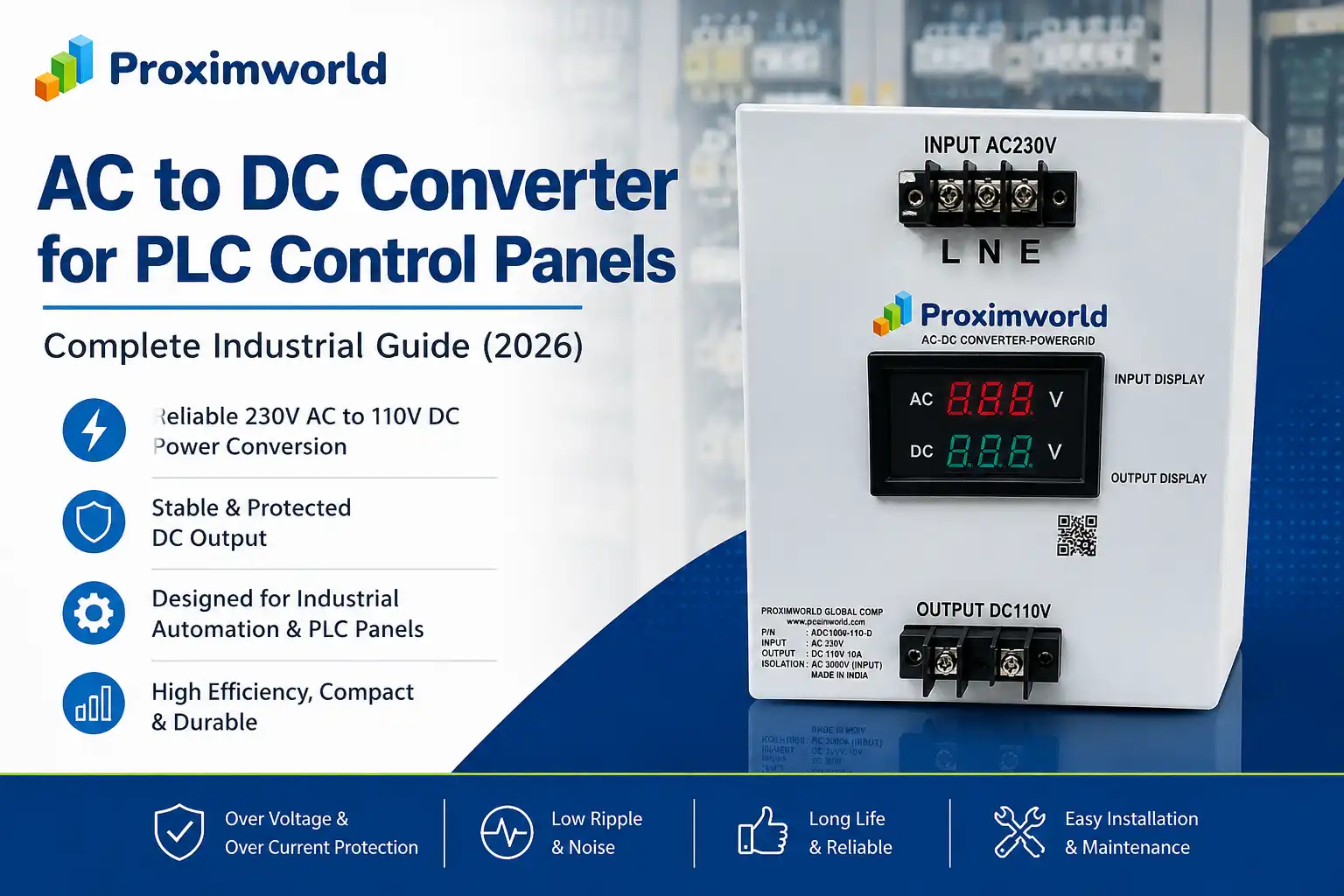
Choosing the right AC to DC converter is not a minor purchasing decision — it directly determines the reliability, safety, and lifespan of a PLC control panel. An undersized or poor-quality power supply can cause nuisance tripping, PLC brownouts, sensor malfunctions, and unplanned downtime that costs far more than the converter itself. In Indian industrial environments, where voltage fluctuations, high ambient temperatures, and dusty panel rooms are common, a correctly specified converter also protects against surges, overloads, and thermal stress. Getting this decision right at the design stage saves significant maintenance cost and production loss over the equipment’s operating life.
Table of Contents
Walk into almost any Indian factory floor today — an automotive assembly line, a food processing plant, a textile unit, or a water treatment facility — and you will find a PLC control panel quietly running the show. Behind every one of those panels sits a component that rarely gets the attention it deserves: the AC to DC converter. It is easy to treat the power supply as an afterthought once the PLC, HMI, and I/O modules have been selected. In practice, the converter is the foundation everything else depends on.
This guide is written for engineers, panel builders, OEMs, and procurement teams who need a practical, technically sound approach to selecting an AC to DC converter for PLC control panels in 2026. We will cover how these converters work, what specifications actually matter, the types available in the Indian market, common mistakes that lead to premature failure, and a buying checklist you can use during your next panel design or tender evaluation. Whether you are specifying a 24V DC power supply for a new machine build or replacing an aging unit during a plant upgrade, the goal is the same — reliable, safe, and efficient power for your automation system.
A PLC control panel is an enclosed assembly that houses a Programmable Logic Controller along with the supporting electrical components needed to operate machinery or a process safely. Typically, a panel includes the PLC CPU and I/O modules, terminal blocks, circuit breakers, relays, contactors, an HMI or operator interface, and — critically — a power supply unit that converts incoming AC mains into clean, regulated DC voltage.
Most industrial plants in India receive 230V single-phase or 415V three-phase AC supply from the grid or a captive generator. However, PLCs, sensors, proximity switches, solenoid valves, and most field instrumentation are designed to operate on low-voltage DC — commonly 24V DC, and in some legacy or specific applications, 110V DC or 48V DC. This is precisely where the AC to DC converter earns its place inside the panel: it bridges the gap between the incoming utility power and the low-voltage DC that the control system actually needs.
A PLC control panel is only as reliable as its weakest component. Many panel failures traced back to “PLC issues” are, on closer inspection, actually power supply issues — voltage sag, ripple, or overload on the DC bus.
A PLC’s internal logic, its input/output circuits, and nearly every sensor connected to it operate on regulated DC voltage. Feeding raw, unregulated AC directly to these components is simply not possible without damaging them. An industrial AC to DC converter performs several essential functions inside a control panel:
In short, the converter is not just a “power adapter” — it is a safety-critical and performance-critical component of the entire automation system. A well-chosen PLC power supply reduces nuisance faults, protects downstream electronics, and extends the operating life of the whole panel.
Selecting the right AC to DC converter for PLC control panels involves more than matching a voltage label. Below are the technical factors that experienced panel builders evaluate before finalizing a converter.

Confirm whether your incoming supply is single-phase 230V AC or a wider universal input range (such as 85–265V AC), which handles voltage fluctuations common in Indian industrial areas without derating or failure.

Most PLC systems run on 24V DC, though legacy systems may require 110V DC. Calculate the total current draw of PLCs, HMIs, sensors, and actuators, then add 20–30% headroom for expansion and inrush current.

Undersizing wattage is a frequent design error. Always size the converter based on the peak simultaneous load of the panel, never the average load, to avoid nuisance shutdowns.

Higher efficiency converters (above 85–90%) generate less heat, which is vital in enclosed panels without forced ventilation, especially in Indian summers where temperatures exceed 45°C.

Look for short-circuit protection, over-voltage protection, overload protection, and thermal shutdown as a minimum standard to protect expensive PLCs and connected field components.

DIN rail mounted units are the industry standard for control panels. They save installation space, simplify panel wiring, and match standard layouts of other automation parts.

Verify compliance with standard industrial norms (such as IEC 61010, CE marking, and RoHS), particularly if the panel is intended for export or machinery sold to multinational clients.

Check the converter’s rated operating temperature range against actual panel environments, especially for panels installed near furnaces, engines, or hot outdoor enclosures.
| Application | Typical Input | Typical Output |
|---|---|---|
| Standard PLC Logic & I/O | 230V AC | 24V DC |
| Legacy Relay & Control Circuits | 230V AC | 110V DC |
| Telecom & Signalling Panels | 230V AC | 48V DC |
| Instrumentation Loops | 230V AC | 12V DC |
| Heavy Industrial Machines (3-phase input) | 415V AC 3-phase | 24V DC / 110V DC |
| Panel Type | Approx. Load | Recommended Wattage |
|---|---|---|
| Small Machine Panel (single PLC, few sensors) | 2–5A @ 24V DC | 150–200W |
| Medium Automation Panel (PLC + HMI + I/O rack) | 6–12A @ 24V DC | 300–500W |
| Large Process Panel (multiple I/O racks, drives) | 15–25A @ 24V DC | 600–1000W |
| Heavy Duty / Multi-Machine Panel | 25A+ @ 24V DC | 1200W and above |
Panel builders sourcing units in this range often look at options such as the 230V to 110V DC industrial power supply (150W–1200W), which covers small machine panels through heavy-duty applications within a single product family.
Not all converters are built the same way. Understanding the underlying technology helps you match the right unit to your application.

These use a step-down transformer, rectifier, and linear regulator. They are simple and produce very low output noise but are heavy, bulky, and inefficient, generating significant heat. Largely being phased out in modern panel designs.

SMPS units switch power at high frequency, allowing smaller size, lighter weight, and much higher efficiency (often 85–95%). This is the dominant technology in modern PLC control panel power supply designs.

A mounting-style category rather than a technology, DIN rail units (usually SMPS-based) snap directly onto standard panel rails, saving wiring time, structural layout space, and streamlining cabinet layout.

Two converters run in parallel with a redundancy module. If one unit fails, the other seamlessly takes over the load — used in critical processes where downtime is unacceptable (e.g., pharmaceuticals).
| Parameter | Linear Power Supply | SMPS (Switch Mode) |
|---|---|---|
| Efficiency | Low (50–60%) | High (85–95%) |
| Size & Weight | Large and heavy | Compact and lightweight |
| Output Noise | Very low | Low (with good filtering) |
| Heat Generation | High | Low to moderate |
| Typical Panel Use Today | Rare / legacy panels | Industry standard |
| Advantages | Disadvantages |
|---|---|
|
✔ High efficiency, lower running cost
✔ Compact DIN rail form factor saves panel space
✔ Wide input voltage tolerance
✔ Built-in protection features widely available
|
✘ Can introduce switching noise if poorly filtered
✘ Requires quality components to ensure long service life
✘ Cheaper units may lack robust protection circuitry
✘ Sensitive to poor grounding practices if not installed correctly
|
For engineers evaluating options, browsing the full AC to DC converter category is a useful way to compare wattage ranges and configurations side by side before finalizing a specification.
| Protection Type | Purpose |
|---|---|
| Short Circuit Protection (SCP) | Shuts down or limits output during a downstream short circuit |
| Over Voltage Protection (OVP) | Protects connected PLC and devices from voltage spikes |
| Overload Protection (OLP) | Prevents damage when connected load exceeds rated capacity |
| Over Temperature Protection (OTP) | Auto shutdown or derating during excessive internal heat |
| Input Surge Protection | Absorbs transient spikes from the incoming AC line |
Industrial power supply units built around AC to DC conversion technology serve a wide range of automation and infrastructure use cases across Indian industry:

Powering PLCs, conveyor proximity sensors, and robotic interface panels running continuously across high-throughput shifts.

Supplying 24V DC to washdown-rated control panels operating in highly humid and mildly corrosive environment lines.

Powering control panels for spinning, weaving, and dyeing machines that run near-continuously in lint-heavy room environments.

Powering SCADA-integrated PLC panels controlling flow valves, automated pump systems, and ultrasonic level sensors.

Driving photo-eyes, divert actuators, high-speed sorting gates, and PLC logic lines in high-speed packaging centers.

Standardizing on a compact, reliable PLC power supply across product lines to simplify component sourcing and support.
A textile mill in Gujarat experienced repeated PLC resets on a dyeing line every time nearby motor starters kicked in. Investigation traced the issue not to the PLC itself, but to a low-quality, undersized converter that could not maintain stable output during the voltage sag caused by motor inrush. Replacing it with a correctly sized, higher-efficiency industrial converter with better input tolerance resolved the resets permanently.
Even the best converter can underperform if installed incorrectly. Follow these step-by-step best practices when installing an AC DC converter in a control panel.
Even experienced teams sometimes repeat the same avoidable errors when specifying or installing an AC to DC converter for PLC control panels.
Sizing a converter based only on the PLC’s nameplate current, while ignoring HMI, relays, sensors, and future expansion, is the single most common cause of premature power supply overload in the field. Always calculate total connected load and add margin before finalizing wattage.
When in doubt between two wattage options, choose the higher rating. Running a converter at 60–70% of its rated capacity generates less heat, extends component life, and leaves room for panel modifications later — a small upfront cost that pays back many times over in reduced downtime.
Choosing the right AC to DC converter for PLC control panels is a decision that pays dividends over the entire operating life of a machine or process line. It affects panel reliability, safety, maintenance cost, and ultimately, plant uptime. By evaluating input voltage range, output requirements, wattage with proper margin, efficiency, protection features, and mounting compatibility, engineers and panel builders can avoid the costly mistakes that lead to nuisance trips and premature failures.
Whether you are designing a new panel or upgrading an existing installation, investing in a well-built industrial AC to DC converter is one of the simplest ways to strengthen the foundation of your automation system. ProximWorld offers a range of industrial-grade converters engineered for Indian factory conditions, backed by clear technical documentation and dependable support — helping engineering teams build panels that perform reliably, shift after shift, year after year.

Leave a comment