
No products in the cart.

The Invisible Backbone of Every EV
The electric vehicle revolution is moving fast—but not everything driving it forward is visible. Beneath the headlines about battery range and motor performance lies a component that silently enables it all: the DC-DC converter. Without it, your infotainment system goes dark, your ADAS fails, and your auxiliary battery drains dead.
This isn't a peripheral component. It's foundational infrastructure—the power bridge between your EV's high-voltage drivetrain and every low-voltage system that makes the vehicle usable, safe, and intelligent.
Key Insight: Every electric vehicle on the road today relies on at least one DC-DC converter. As EV architecture grows more complex—with autonomous systems, V2G capability, and solar integration—these converters become not just useful, but indispensable.
What Is a DC-DC Converter in an EV?
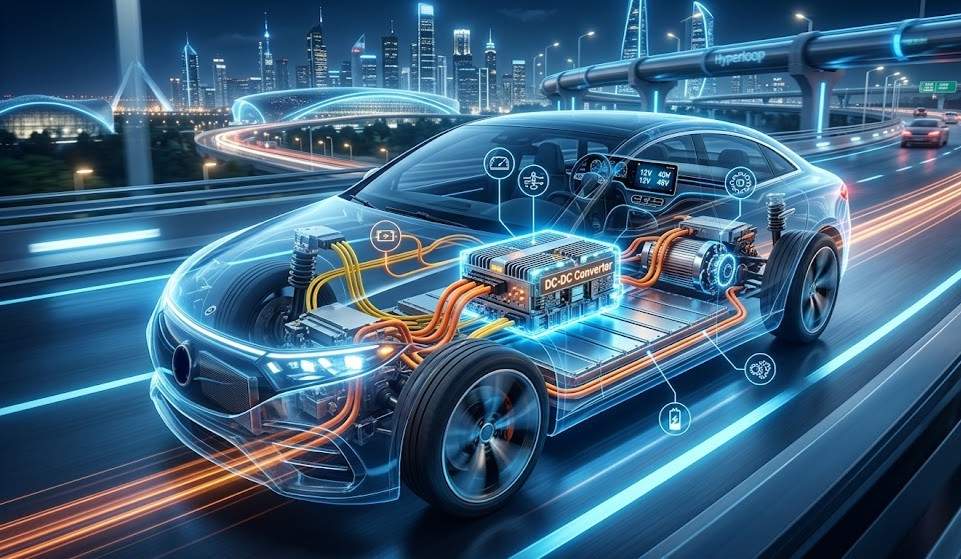
A DC-DC converter is a power electronics device that transforms one DC voltage level into another. In EVs, this means stepping down the high-voltage main battery pack—typically operating between 400V and 800V—down to a stable 12V or 24V output for auxiliary systems.
In traditional ICE vehicles, an alternator handles this job. In EVs, the DC-DC converter does it more efficiently, more reliably, and with far greater precision.
HIGH VOLTAGE BATTERY
400–800V
12V / 24V
AUXILIARY SYSTEMS
- Lighting & Signal Systems
- Infotainment & Navigation
- Sensors & ADAS Modules
- Safety & Comms Systems
Why DC-DC Converters Are Essential
Modern EVs operate across multiple voltage domains simultaneously. DC-DC converters are the engineering solution that makes this multi-tier architecture seamless, stable, and safe.
Voltage Management
Acts as the bridge between high- and low-voltage domains—ensuring stable power delivery, precise regulation, and protection against electrical overload.
Auxiliary Power Supply
Powers every onboard electronic—from dashboard displays to ADAS—continuously and reliably. Replaces the alternator with greater efficiency and no moving parts.
Energy Efficiency & Range
High-efficiency converters (90–98%) minimize conversion losses, which directly translates to more kilometers per charge and lower thermal loads on the battery.
Battery Health & Longevity
Regulates voltage precisely to prevent overcharging and deep discharge—two of the primary causes of early battery degradation in EVs.
Advanced EV Technologies
Autonomous systems, AI processors, and real-time data modules demand stable, clean power. DC-DC converters are the reason these high-performance systems can exist inside a vehicle.
Safety & Isolation
Isolated converter topologies protect sensitive electronics from high-voltage faults—a non-negotiable requirement in automotive safety standards.
How It Works: The Power Path
The conversion process is continuous and automatic. Every time you turn on a system in your EV, the DC-DC converter is already working.
Main Battery
400V – 800V DC
DC-DC Converter
Step-Down · 90–98% eff.
Low-Voltage Bus
12V / 24V DC
Vehicle Systems
ADAS · Lights · Comms
← Scroll to explore →
Role in Future EV Technologies
Next-generation DC-DC converters are no longer passive components—they're active participants in the intelligence of tomorrow's vehicles.
Bidirectional Power Flow
Advanced bidirectional converters allow energy to flow in both directions—enabling regenerative braking recovery, Vehicle-to-Grid (V2G) energy export, and intelligent energy redistribution between systems. This is a cornerstone of the smart mobility ecosystem.
Renewable Energy Integration
As EVs incorporate rooftop solar panels and connect to DC microgrids, converters manage the complex interplay between solar input, battery storage, and vehicle load—efficiently and without human intervention.
Compact, High-Power Designs
Wide-bandgap semiconductors (SiC and GaN) are enabling converters that are smaller, run cooler, and handle higher power densities. For EV manufacturers, this means lighter vehicles and more design freedom—without sacrificing performance.
Applications Beyond Electric Vehicles
The same technology that powers your EV's electronics is trusted across demanding industries worldwide.
EV Systems
Auxiliary power, ADAS, infotainment, and battery management
Solar Energy
Maximum power point tracking and inverter support
Telecom
Base station power, redundant supply systems
Industrial
Automation, robotics, and motor drive systems
Railway
Traction support, onboard electronics, lighting
Healthcare
Medical imaging, portable devices, life-critical systems
How to Choose the Right DC-DC Converter
Selecting the right converter for your application is a critical engineering decision. Here's what to evaluate.
-
01
Input & Output Voltage Range
Ensure compatibility with your system's exact voltage architecture. Mismatched specifications cause instability and can damage downstream electronics.
-
02
Efficiency Rating
Target converters with 93%+ efficiency for automotive applications. Every percentage point of loss translates to heat, wasted energy, and reduced range.
-
03
Isolation Requirements
Isolated converters provide galvanic separation between input and output—essential for safety-critical automotive and medical applications.
-
04
Thermal Management
Evaluate operating temperature range, thermal resistance, and cooling requirements. Automotive-grade converters must operate reliably from -40°C to +125°C.
-
05
Application-Specific Design
Automotive, industrial, and medical applications have distinct certification requirements (AEC-Q100, ISO 26262, IEC 60601). Always match the converter to the compliance standard your application demands.
Conclusion
DC-DC converters may not earn headlines, but they earn their place in every EV ever built. They are the quiet engineering infrastructure behind every screen that lights up, every sensor that fires, and every kilometer driven safely.
As EVs grow more sophisticated—integrating autonomous systems, bidirectional grid connectivity, and renewable energy sources—the demands placed on power electronics will only intensify. The converters that handle those demands reliably and efficiently will define which vehicles succeed.
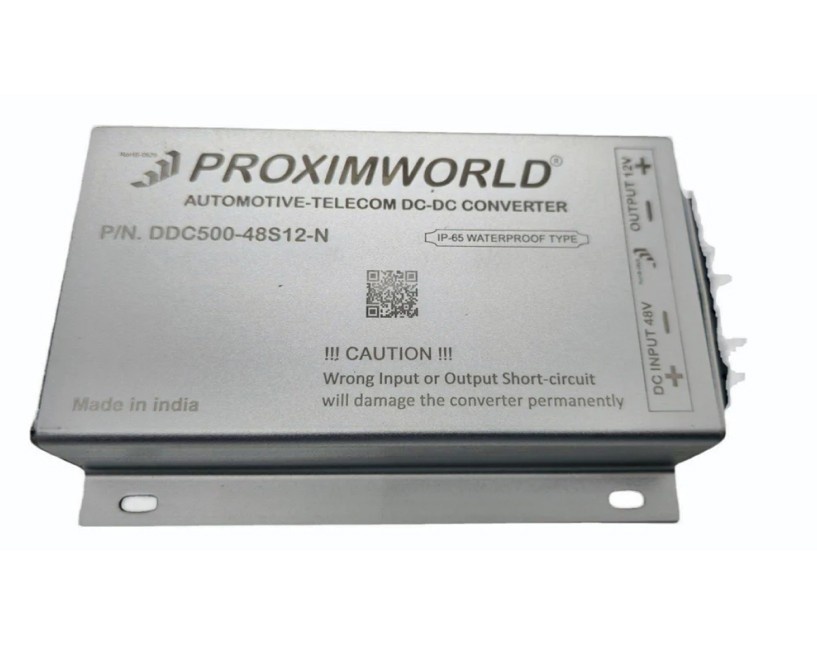
For engineers, procurement specialists, and system integrators working in electrification: choosing the right DC-DC converter is not a detail. It's a foundational decision that affects performance, safety, and longevity across the entire vehicle lifecycle.

Leave a comment