
No products in the cart.

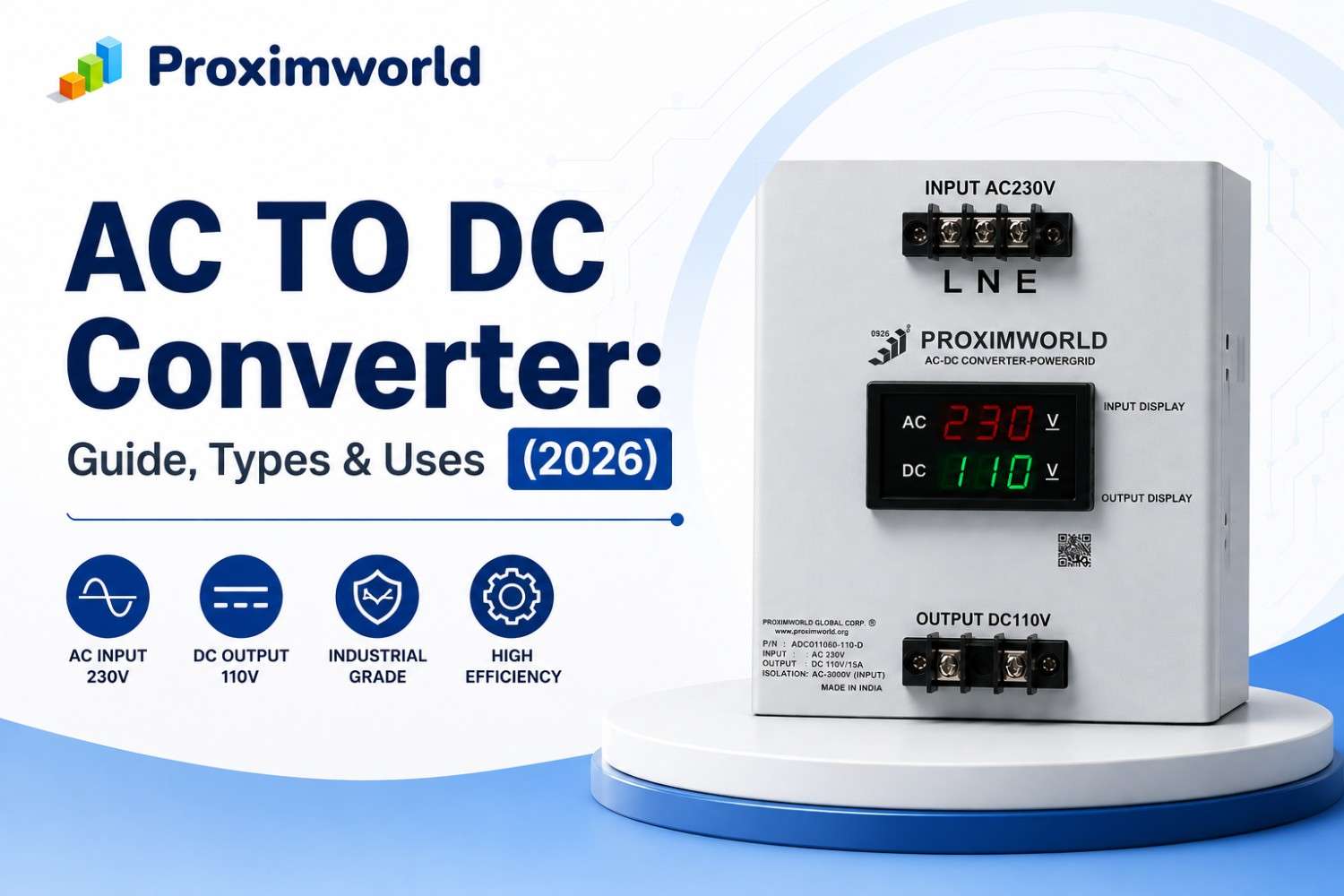
Whether you’re powering industrial machinery, running sensitive electronics, or setting up a reliable off-grid system, understanding AC to DC converters is essential. These unsung workhorses of modern electronics are found in virtually every powered device — from your laptop charger to heavy-duty manufacturing equipment.
This complete guide covers what AC and DC are, how conversion works step by step, the types of converters available, their industrial applications, and how to choose the right one for your needs.
📋 Table of Contents
Before diving into converters, it’s worth clarifying what AC and DC actually mean — the difference fundamentally shapes how every electronic device is designed and powered.
An AC to DC converter — also called a rectifier or power supply unit — is an electronic device that transforms alternating current (AC) from a power
grid into direct current (DC) suitable for electronic circuits and equipment.
In simple terms: it takes the “wavy,” reversing electricity from your power outlet and converts it into the smooth, one-directional flow that electronics actually need to function. The black brick on your laptop charger, the power supply inside your
desktop PC, and the control boards in factory machines all contain AC to DC conversion circuits.
The conversion from AC to DC is a carefully staged process involving four core stages:
Not all AC to DC converters are built the same. The right type depends on your power requirements, efficiency needs, size constraints, and application.
Combines a mains transformer with full-wave rectification, filtering, and a linear voltage regulator. Produces very low noise output — excellent for audio equipment, test instruments, and RF circuits. Downsides: heavy, bulky, and only 30–60% efficient,
generating significant heat.
The dominant technology in modern electronics. Operates at high switching frequencies (20 kHz–2 MHz), enabling compact designs and high efficiencies of 80–95%. Used in computer PSUs, industrial equipment, LED drivers, and battery chargers. Key topologies
include:
Uses Silicon Controlled Rectifiers to produce adjustable DC output from AC input. The output voltage is controlled by varying the firing angle of the thyristors. Widely used in DC motor drives, electroplating, and battery chargers where variable DC
voltage is required.
Advanced SMPS designs with an active PFC stage that draws near-sinusoidal current from the AC line, improving power factor close to 1.0. Required by EN61000-3-2 standards for equipment above 75W in Europe and essential in industrial-grade power supplies.
| Converter Type | Advantages | Disadvantages |
|---|---|---|
| Linear Power Supply | Very low output noise, simple design, excellent regulation | Heavy, large, 30–60% efficiency, generates heat |
| SMPS | High efficiency (80–95%), compact, wide input range | EMI generation, more complex circuit design |
| Controlled Rectifier | Adjustable output voltage, handles high currents | Low power factor, harmonics, slower response |
| PFC Converter | Near-unity power factor, meets regulatory standards | Higher cost, more components, complex design |
In industrial environments, AC to DC converters form the power backbone of control systems, automation, and production equipment.
PLCs, servo drives, variable frequency drives (VFDs), and sensor networks all require stable DC power. Industrial power supplies must handle wide temperature ranges, vibration, and continuous-duty operation without failure.
Controlled rectifiers and SMPS units provide adjustable DC voltage to drive DC motors at variable speeds in conveyor systems, pumps, fans, compressors, and CNC machine tools.
From telecom backup batteries to EV charging stations and forklift chargers, AC to DC converters with controlled current output handle bulk charging, absorption, and float stages efficiently.
Metal finishing, anodizing, and electrochemical processes require high-current, low-ripple DC supplies at precisely controlled voltages — controlled rectifiers capable of delivering hundreds to thousands of amperes are standard.
Telecom equipment runs on 48V DC buses. Large rectifier systems convert AC mains to this standard voltage, with N+1 redundancy for uninterrupted operation.
High-power LED arrays require constant-current DC drivers derived from AC input. Industrial LED power supplies are designed for long life (50,000+ hours) in harsh environments.
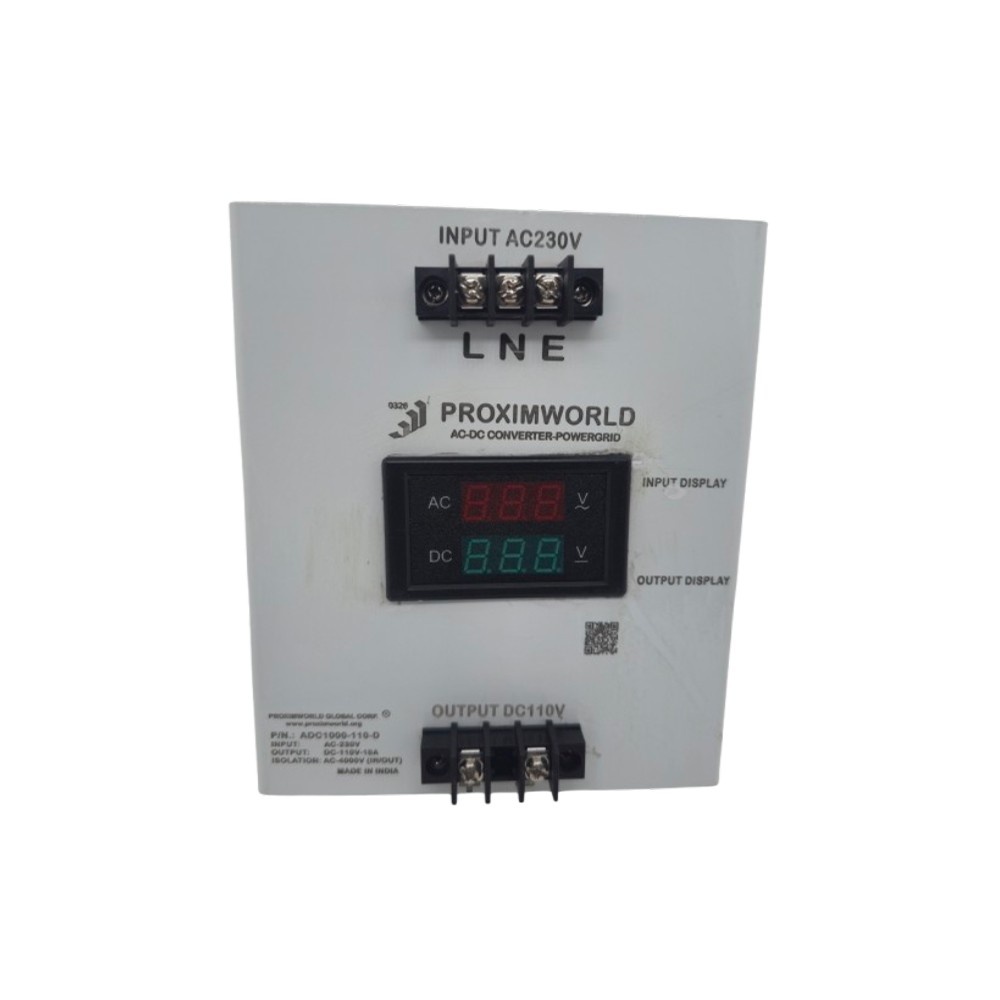
Proximworld AC to DC Converter — 230V AC Input to 110V DC Output, available from 150W to 1200W for industrial applications
The Proximworld industrial power supply series is designed for professionals who need reliable, continuous DC power in demanding environments. Covering 150W to 1200W, this range handles everything from light-duty automation to heavy industrial
workloads.
This converter fits particularly well in facilities that operate legacy 110V DC equipment or American-standard DC machinery but are supplied with 230V AC from the grid — common in export manufacturing, mixed-standard factories, and facilities upgrading
older infrastructure. The wide wattage range (150W–1200W) means the same product line covers control panel power supplies at the low end and motor-drive power stages at the high end, simplifying procurement.
View the full range at the Proximworld AC to DC Converter product category.
Calculate total load wattage and add a 20–30% headroom buffer. Running a converter at 100% rated load continuously shortens its life. If your equipment
draws 500W peak, choose a 650W–700W supply.
Match the output voltage precisely to your equipment’s requirements. Ensure the converter can supply peak current demand — motors and solenoids have high inrush currents at startup (3–10× running current).
Choose a universal input range (85–265V AC) if the supply may operate in different countries or grid conditions. This also provides resilience against grid fluctuations common in industrial environments.
For professional and industrial use, look for CE marking (EU), UL/ETL listing (North America), and RoHS compliance. These certifications confirm the design has been independently tested for safety and EMI compliance.
| Feature | Industrial AC to DC Converter | Consumer AC Adapter |
|---|---|---|
| Power Range | 50W to 10,000W+ | 5W to 100W typical |
| Regulation | Tight (±1–3%) | Loose (±5–15%) |
| Duty Cycle | Continuous (24/7 rated) | Intermittent only |
| Protections | Full OVP, OCP, OTP, SCP | Basic fuse only |
| Operating Temp | −20°C to +70°C | 0°C to +40°C |
| MTBF | 100,000+ hours | Not specified |
Explore the Proximworld range of industrial AC to DC converters — 150W to 1200W, engineered for continuous-duty performance in demanding environments.
AC to DC converters are one of the most fundamental components in modern electrical systems. Whether it’s a compact flyback converter powering a PLC’s control board or a 1200W industrial power supply driving a DC motor, the quality of your AC to DC
conversion directly affects reliability, efficiency, and safety. Always select a converter with proper wattage headroom, full protection features, and certification for your environment — and it will serve your operation reliably for years.

Leave a comment