
No products in the cart.

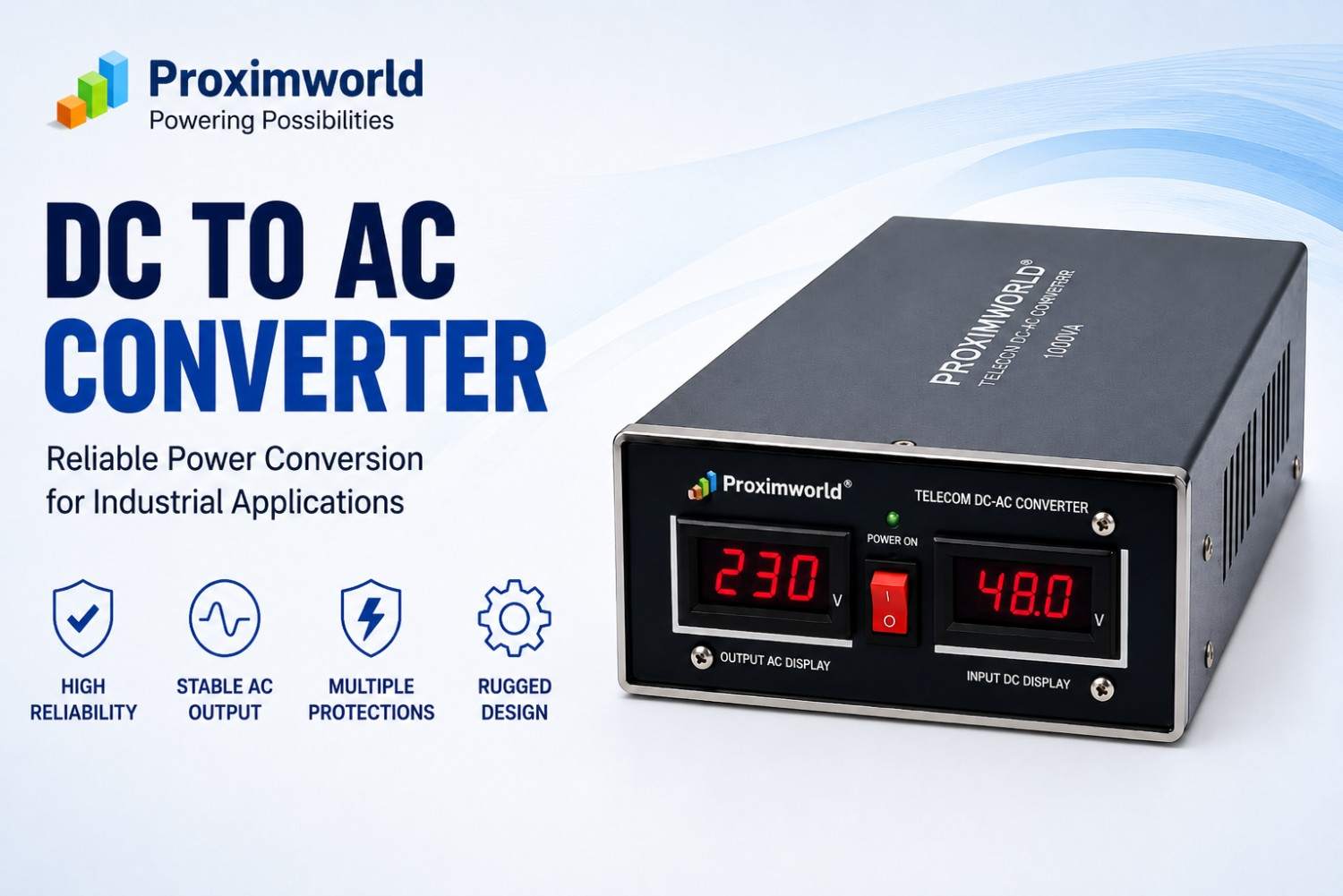
Table of Contents
In industrial environments where power reliability is non-negotiable, DC to AC converters — commonly known as inverters — are among the most critical pieces of electrical equipment on the floor. They take stored or generated direct current (DC) power and convert it into alternating current (AC), which is the standard form of electricity
used to run motors, machinery, control systems, lighting, and more.
From manufacturing plants and oil refineries to renewable energy installations and data centres, the demand for high-performance inverters continues to rise. According to industry analysts, the global power inverter market was valued at over
USD 9.7 billion in 2023 and is projected to grow at a CAGR of approximately 6.2% through 2030 — driven largely by industrial automation, renewable energy adoption, and the need for uninterrupted power
supply (UPS) systems.
This guide breaks down everything industrial buyers and engineers need to know about DC to AC converters:
how they function, the types available, the features that matter most, and how to select the right unit for your specific application.
A DC to AC converter operates through a process called inversion. At its core, the device uses switching components — typically MOSFETs or IGBTs — to rapidly switch the DC input in a pattern that simulates
an AC waveform. A control circuit (often microprocessor-based) governs the switching frequency and timing, while filters smooth the output into a stable, usable AC signal.
Modern industrial inverters also include protection circuits for over-voltage, under-voltage, overload, short circuit, and thermal shutdown — ensuring equipment and personnel safety at all times.
Not all inverters are created equal. For industrial applications, understanding the differences between converter types is essential for system efficiency, equipment compatibility, and total cost of ownership.
Produces an AC output identical to utility grid power. Ideal for sensitive industrial equipment, motors, variable frequency drives (VFDs), and medical devices. The highest quality output, with low total harmonic distortion (THD <3%).
Generates a stepped approximation of a sine wave. More affordable, suitable for resistive loads, basic tools, and lighting. Not recommended for sensitive electronics or inductive loads requiring precision AC waveforms.
Synchronises with the utility grid to feed excess power back into the grid. Widely used in solar industrial installations and energy management systems. Requires anti-islanding protection and grid synchronisation capabilities.
Delivers three-phase AC output for industrial motors and heavy-duty equipment. Offers superior load balancing, higher efficiency, and lower ripple. Standard in manufacturing, HVAC systems, and large-scale process control.
When evaluating DC to AC converters for industrial deployment, the feature set determines long-term reliability,
safety, and operational efficiency. Below are the critical specifications every procurement engineer should assess.
Industrial inverters must handle both continuous load (rated wattage) and surge loads — the brief power spikes that occur when motors or compressors start. A good industrial converter should offer at least 2–3× surge capacity above its continuous rating. Sizing an inverter too close to continuous load without surge headroom is a common cause of failure.
Total Harmonic Distortion (THD) is a key quality indicator. Industrial-grade converters targeting sensitive loads should maintain THD below 3%. Higher THD can cause motor overheating, equipment damage,
and interference with control systems.
Efficiency directly impacts operating costs and heat generation. Best-in-class industrial inverters achieve 95–98% efficiency at typical load levels. Higher efficiency means less energy wasted as heat and
lower cooling requirements for enclosures.
Industrial DC sources can vary — battery banks fluctuate as they charge and discharge, and solar arrays vary with irradiance. A wide input voltage range (e.g., 10–16V for a 12V nominal system) ensures reliable operation without shutdowns during
real-world voltage fluctuations.
Galvanic isolation between DC input and AC output is critical in many industrial applications for operator safety and noise immunity. Look for compliance with IEC 62040, CE marking, UL certification, and relevant regional standards for your market.
DC to AC converters are deployed across a remarkably wide range of industrial sectors. Their versatility,
scalability, and reliability make them indispensable in modern industrial infrastructure.
Powering CNC machines, robotic arms, conveyor drives, and PLCs from DC battery backups during grid outages. Ensuring zero downtime on critical production lines.
Converting solar panel DC output to grid-compatible AC for industrial facilities. Enabling off-grid industrial operations in remote sites, mines, and agricultural installations.
UPS inverters maintaining AC power for servers during grid interruptions. DC distribution systems converting battery DC to AC for server room equipment with extremely tight voltage regulation.
Powering remote instrumentation, telemetry, pumping systems, and safety equipment in locations without grid access. Rugged, explosion-proof inverter units are standard in these environments.
Providing seamless AC power from battery banks for critical medical equipment, operating theatre lighting, and life support systems during grid failures.
EV charging infrastructure, railway traction systems, and auxiliary power units in commercial vehicles all rely on high-power DC to AC converters for efficient, clean energy delivery.
Beyond the basic function of power conversion, industrial DC to AC inverters deliver a range of strategic
and operational advantages.
Use this comparison table to quickly identify which type of inverter best suits your industrial power requirements.
| Inverter Type | Waveform | Efficiency | Cost | Best For |
|---|---|---|---|---|
| Pure Sine Wave | Smooth sine | 93–98% | High | Sensitive electronics, motors, VFDs |
| Modified Sine Wave | Stepped | 85–92% | Low–Medium | Resistive loads, basic tools, lighting |
| Grid-Tie | Grid-synced | 95–99% | High | Solar, wind, energy export |
| Three-Phase | Three-phase AC | 94–98% | High | Heavy motors, HVAC, large equipment |
| Isolated Inverter | Sine (isolated) | 90–96% | Medium–High | Medical, marine, hazardous environments |
Selecting the correct DC to AC converter requires a systematic evaluation of your application’s power demands,
environmental conditions, and operational requirements. Follow this step-by-step selection process:
Expert Insight: Over 40% of inverter failures in industrial settings are attributed to incorrect sizing — particularly underestimating surge requirements from motor loads. Always consult a qualified power systems engineer
and review the manufacturer’s derating curves for your specific ambient temperature.
Explore our full range of industrial-grade DC to AC converters — engineered for reliability, efficiency,
and demanding environments. Our technical team is ready to help you specify the perfect solution.
DC to AC converters are far more than simple power conversion devices — they are strategic enablers of
industrial resilience, energy efficiency, and sustainability. Whether your facility relies on battery-backed UPS systems, solar energy, or remote off-grid power, selecting the right inverter is critical to operational continuity and long-term
cost performance.
The industrial landscape is evolving rapidly. Rising energy costs, decarbonisation targets, and the proliferation of sensitive digital equipment all demand higher standards from power conversion technology. Pure sine wave output, high efficiency
ratings, comprehensive protection, and robust certification are no longer premium extras — they are baseline requirements for serious industrial deployments.
By understanding the types, features, applications, and selection criteria covered in this guide, industrial buyers, engineers, and procurement teams can make informed decisions that protect equipment, reduce operational costs, and future-proof
their power infrastructure. Explore our range of industrial DC to AC converters and speak with our
technical experts to find the perfect match for your application.

Leave a comment