
No products in the cart.

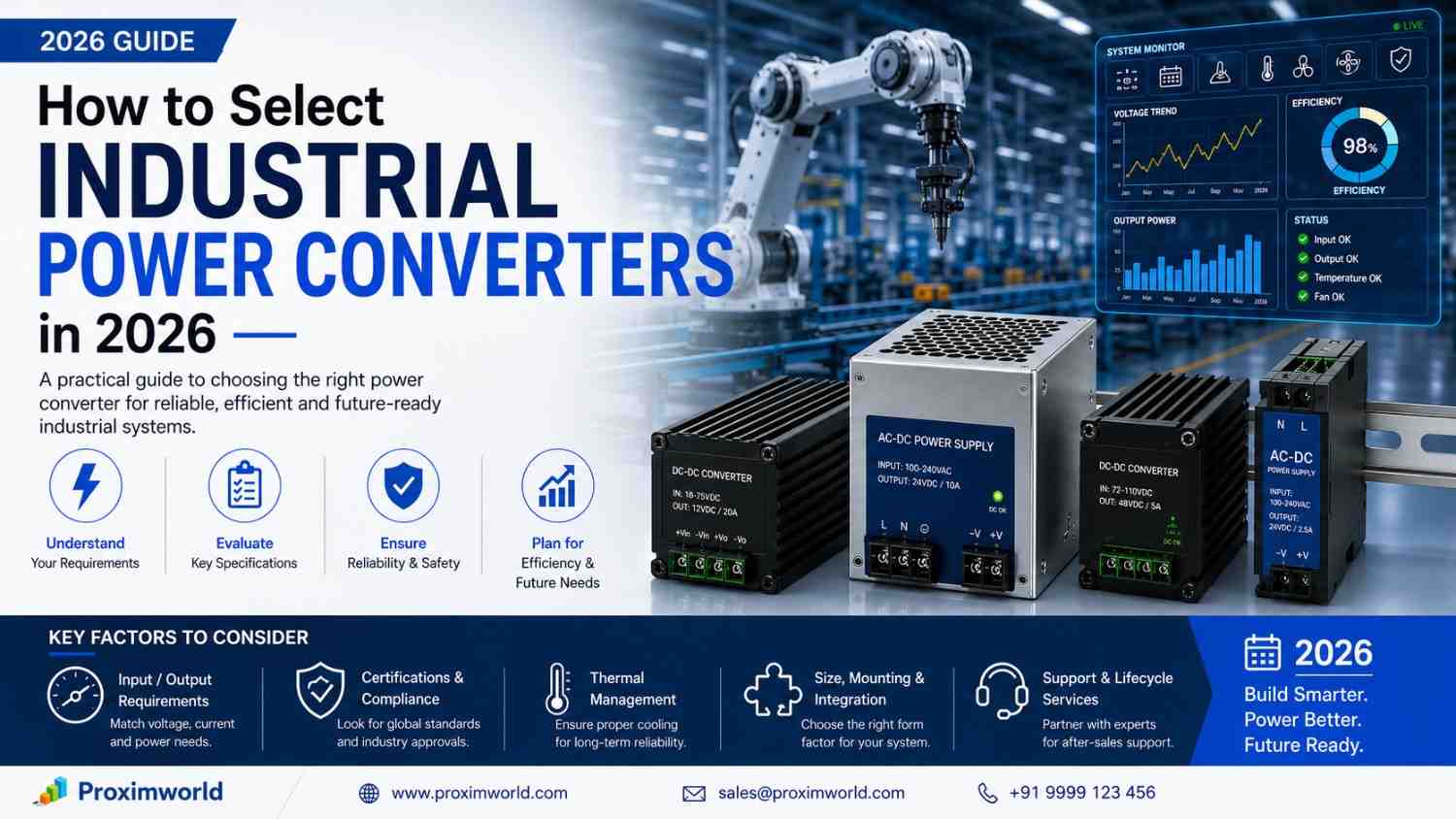
How to Select Industrial Power Converters in 2026: A Complete Buyer’s Guide
Selecting the right industrial power converter is one of the most consequential decisions an engineer or procurement manager can make. Whether you are upgrading an existing facility, commissioning new equipment, or designing a ruggedized system for harsh field conditions, the wrong choice can cost thousands in downtime, wasted energy, and premature hardware failure.
In 2026, the landscape of power electronics has evolved considerably. Wider adoption of wide-bandgap semiconductors, tighter EMC regulations in industrial zones, and the growing demand for high-density DC power supply solutions mean that buyers face more options — and more variables — than ever before.
This guide walks you through everything you need to know: from core technical parameters and key application scenarios, to a practical comparison of the most common converter topologies available today. By the end, you will have a clear framework for selecting industrial DC-DC converters and related power solutions with confidence.
Benefits of Choosing the Right Industrial Power Converter
Before diving into specifications, it helps to understand why investing in a properly matched converter pays for itself many times over. Cheap or mismatched units lead to thermal runaway, electromagnetic interference with sensitive sensors, and warranty voids on connected equipment. The right unit, properly specified, delivers the opposite.
Energy Efficiency
Modern industrial converters routinely achieve 93–97% efficiency, dramatically reducing cooling requirements and operating costs across continuous-duty cycles.
Reliable Output Stability
Precision regulation keeps output voltage within ±1–2% even under heavy load transients, protecting sensitive PLCs, sensors, and embedded controllers downstream.
Ruggedized Durability
Industrial-grade units tolerate wide input voltage ranges, extreme temperatures (−40 °C to +85 °C), vibration, and humidity — conditions that destroy consumer-grade hardware within weeks.
Longer System Lifespan
Proper voltage conversion prevents thermal and voltage stress on downstream components, extending mean time between failure (MTBF) to 500,000 hours or beyond on premium units.
Industry insight: According to leading industrial electronics procurement teams, over 60% of unplanned line shutdowns trace back to power supply failures — the majority of which are caused by mismatched or under-specified converter units.
Key Industrial Applications
Industrial power converters serve an enormous range of sectors. Understanding where and how your application sits within this landscape is the first step in narrowing down the right specification. Here are the most common deployment environments for DC-DC converters and high-voltage DC power supply units in 2026.
1. Factory Automation & Robotics
Automated assembly lines, robotic arms, and CNC machinery demand ultra-stable 24 V DC rails with tight transient response. Even microsecond voltage drops can trigger E-stop faults in servo drives, costing more in restart time than the converter itself. Look for units with active PFC, low output ripple (<50 mV p-p), and DIN-rail mounting compatibility.
2. Telecommunications & Edge Infrastructure
5G base stations and edge compute nodes typically run on 48 V DC bus architectures. Isolated DC-DC converters step this down to 12 V, 5 V, or 3.3 V for active components. High-density brick-format converters are preferred here, and thermal management is critical in sealed enclosures.
3. Renewable Energy & EV Charging
Solar inverters, battery management systems, and EV charging stations all rely on bidirectional power electronics for efficient energy storage and delivery. Wide input range converters (80–400 V DC input) with synchronous rectification are the standard in this fast-growing segment.
4. Oil, Gas & Mining
Hazardous-area rated converters (ATEX / IECEx certified) are non-negotiable in explosive atmospheres. These must also handle extreme mechanical shock, vibration, and wide ambient temperature swings. Conformal coating on PCBs and sealed housings (IP67 or better) are baseline requirements.
5. Medical & Laboratory Equipment
Medical-grade converters must comply with IEC 60601-1 and provide 2 × MOPP isolation. Low leakage current (<100 µA) and minimal EMI are essential to prevent interference with diagnostic equipment. This is a niche area but demands the most rigorous converter selection of all.
Technical Explanation: What to Look For When Selecting a Converter
Once you have identified your application, it is time to work through the specification sheet in a structured way. Here are the parameters that matter most in industrial electronics procurement — and what the numbers actually mean in practice.
Input Voltage Range
Wider is better for harsh grids. A 3:1 input range (e.g., 18–75 V DC) absorbs generator transients and battery sag without shutting down or triggering OVP.
Output Ripple & Noise
Expressed in mV peak-to-peak. Values below 50 mV are ideal for ADC-sensitive loads. Add external capacitors or an LC filter for further attenuation if needed.
Isolation Voltage
1500 V DC is standard for basic isolation. Safety-critical or medical applications may demand 3000–5200 V DC reinforced isolation between input and output.
Operating Temperature
Check both ambient (Tamb) and case temperature (Tcase) ratings. Derating curves show how power capacity drops above a threshold — critical for enclosed cabinet installations.
Efficiency (η)
Always check efficiency at your actual load point, not just the 100% figure on the front page. Many converters drop sharply below 50% load — a common operating condition in automation.
Protection Features
At minimum, look for OVP, OCP, SCP, and thermal shutdown. Hiccup-mode short circuit protection is safer for inductive loads than latch-off, which requires a manual restart.
Key Specification Tip
Always derate your converter to 70–80% of its rated power in continuous industrial use. A 100 W unit running at 75 W will last significantly longer and run cooler than one running at its nameplate maximum. This single rule eliminates the majority of premature converter failures in the field.
Comparison Table: Common Industrial Converter Types
The table below summarises the four most widely deployed converter topologies in industrial settings, comparing them across the criteria that matter most to procurement and engineering teams.
| Converter Type | Efficiency | Isolation | Cost | Best For |
|---|---|---|---|---|
| Buck (Step-Down) | 90–96% | Non-isolated | Low | Board-level, low-noise rails |
| Boost (Step-Up) | 88–94% | Non-isolated | Low | Battery backup, LED drivers |
| Flyback | 80–90% | Isolated | Medium | Multi-output, low-power isolation |
| Full-Bridge LLC | 93–98% | Isolated | High | High-power industrial, servers |
Efficiency values are approximate and vary by manufacturer, load, and thermal conditions.
Looking for Verified Industrial Power Converters?
Specification knowledge is only half the equation — sourcing matters just as much. Proximworld is a specialist distributor of industrial power electronics, offering technical pre-sales support and a curated catalogue of high-reliability converter units from leading manufacturers.
You can browse their full range of certified and DIN-rail ready units directly at the industrial power converters shop — where products are organised by input/output voltage, power rating, and application category, making it straightforward to match your specification to available stock.
Conclusion
Choosing an industrial power converter in 2026 is a decision that deserves more than a quick datasheet scan. The interaction between voltage conversion topology, operating environment, load profile, and compliance requirements means that no two applications are quite the same — and a unit that performs flawlessly in one setting may fail within months in another.
The framework in this guide — starting from application needs, working through key technical parameters, and finishing with a structured comparison of converter topologies — gives you a repeatable process for making confident, defensible sourcing decisions. Whether you are working with DC-DC converters for DIN-rail automation, high-voltage DC power supply units for renewable energy installations, or isolated bricks for telecom infrastructure, the principles remain the same.
Invest the time to specify correctly upfront. The cost of a properly matched converter is almost always a fraction of the downtime, warranty claims, and re-engineering work that follows a poor selection.
For further guidance or to explore a vetted catalogue of industrial-grade solutions, visit Proximworld.org — specialists in industrial electronics and power conversion products for demanding applications worldwide.

Leave a comment