
No products in the cart.

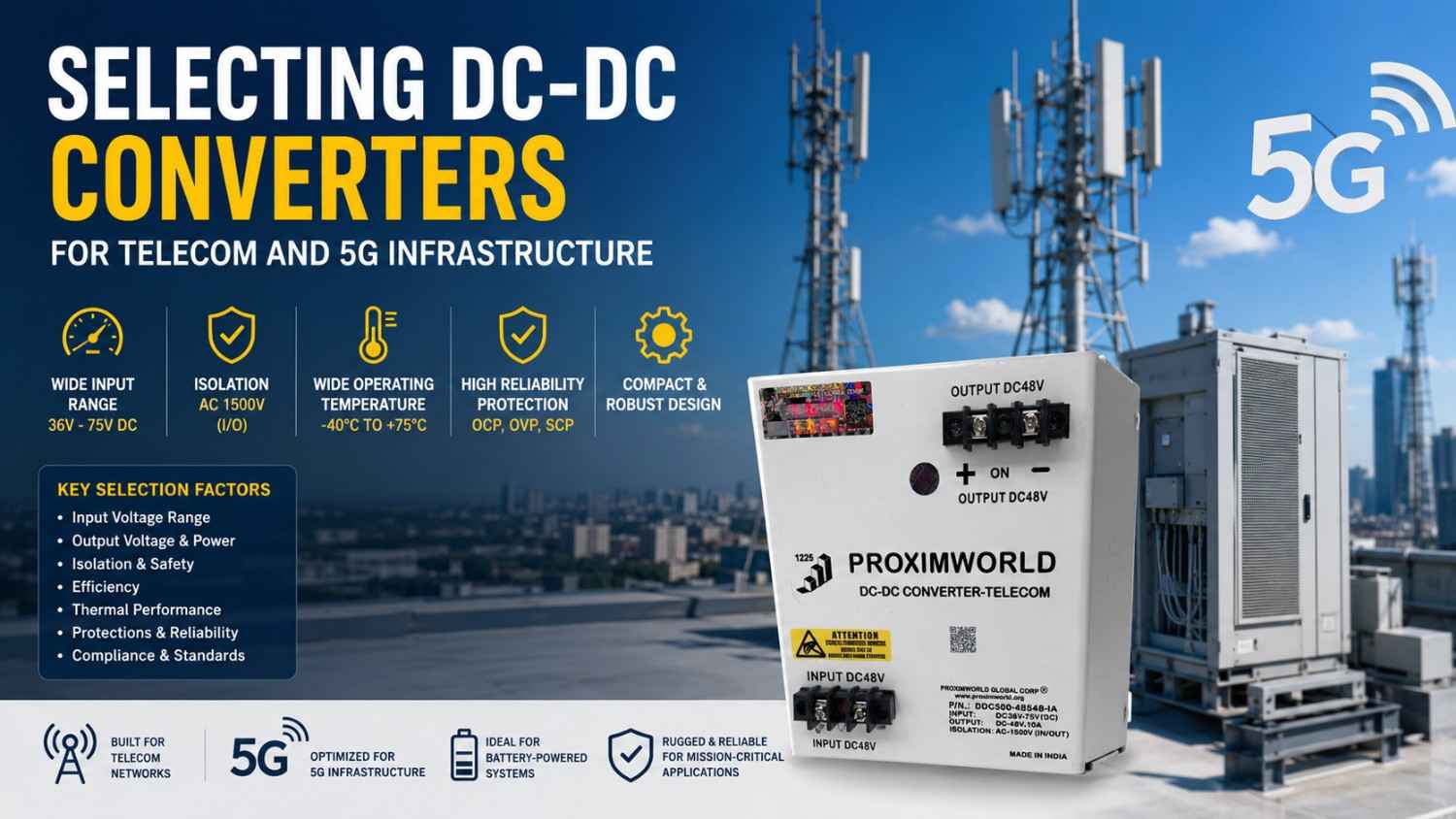
The global rollout of 5G networks is placing extraordinary demands on power infrastructure. From massive MIMO base stations to edge computing nodes and remote radio heads, every component in modern telecom architecture requires precise, stable, and efficient DC power. At the heart of all this sits a deceptively small but enormously important component: the DC-DC converter.
DC-DC converters — devices responsible for voltage conversion between different DC levels — are foundational to power electronics in telecom systems. Unlike consumer-grade applications, telecom and 5G environments demand converters that operate reliably across wide temperature ranges, handle variable loads without flinching, and deliver efficiencies above 95% to minimise heat dissipation in sealed enclosures.
Industry Insight: A typical 5G macro base station consumes between 3 kW and 11 kW of power. Selecting the wrong DC power supply topology can result in thermal runaway, downtime, and significant operational cost — making converter selection a critical engineering decision, not an afterthought.
Whether you are designing a new telecom cabinet, upgrading existing infrastructure, or sourcing components for an industrial electronics project, understanding how to select the right DC-DC converter can directly impact your system’s reliability, efficiency, and total cost of ownership. This guide walks you through everything you need to know.
Modern DC power supply architectures in telecom rely on DC-DC converters for far more than simple step-down or step-up functions. Here is why engineers continue to specify them at every layer of the power chain:
Advanced switching topologies achieve 93–97% efficiency, dramatically reducing heat in enclosed telecom racks and cutting energy costs over multi-year deployments.
Isolated converter topologies protect sensitive baseband hardware from noise and ground faults — essential in distributed antenna systems and remote radio units.
Telecom-grade converters typically accept 36–75 V or 18–75 V input, making them compatible with both –48 V DC bus standards and battery backup systems common across global operators.
Over-voltage, over-current, short-circuit, and over-temperature protection safeguard expensive infrastructure, reducing mean time to repair and lowering operational risk.
Modular DC-DC converter bricks support N+1 redundancy and hot-swap capability, enabling telecom operators to scale capacity without network downtime.
Quarter-brick and eighth-brick packages deliver tens of amps from a footprint smaller than a credit card — critical for space-constrained small cells and outdoor enclosures.
The deployment of power electronics in modern telecom spans a surprisingly broad set of use cases. Here is where DC-DC converters deliver the most impact across the 5G network stack:
Base station equipment uses multiple DC power supply rails — typically 48 V to 12 V, 5 V, and 1.8 V — to power DSPs, FPGAs, and RF amplifiers. High-frequency synchronous buck converters with sub-milliohm output resistance are preferred here for superior transient response during sudden load steps.
Multi-access Edge Computing (MEC) nodes process data locally to reduce latency below 1 ms. These compact servers require point-of-load (POL) DC-DC converters that react within microseconds to CPU power spikes, making voltage regulation accuracy — typically ±1% — paramount in industrial electronics deployments.
High-speed optical modules for DWDM and coherent transmission require clean, ultra-low-noise power. Isolated flyback or LLC resonant converters are widely used here to prevent switching noise from degrading signal integrity in 100G and 400G optical links.
Mounted atop towers and exposed to –40°C to +85°C environments, RRH and AAU units depend on ruggedised DC-DC converters with conformal coatings and wide-temperature silicon to sustain continuous operation through extreme weather cycles.
Understanding the underlying voltage conversion topologies helps engineers make informed choices rather than relying solely on datasheet summaries. Three topologies dominate telecom-grade power electronics:
The synchronous buck converter is the workhorse of point-of-load power in industrial electronics. It uses a high-side MOSFET, a synchronous rectifier, an inductor, and an output capacitor to step voltage down with minimal loss. Modern controllers operating at 300 kHz–3 MHz achieve excellent transient response — critical when 5G processors spike from idle to full load in under 100 microseconds.
For board-level isolation — converting 48 V bus to lower rails while maintaining a galvanic barrier — the phase-shifted full-bridge and LLC resonant topologies are preferred. LLC converters achieve zero-voltage switching (ZVS) across the full load range, reducing switching losses and enabling power densities above 500 W per cubic inch. This makes them ideal in DC power supply modules for blade servers and optical transceivers.
When a telecom subsystem needs to supply a higher voltage from a depleted battery rail — for instance, powering a 24 V fan from a 12 V rail during a –48 V bus brownout — boost converters step in. Wide-bandgap devices based on GaN and SiC are increasingly replacing silicon MOSFETs in boost stages, pushing switching frequencies above 10 MHz and dramatically shrinking inductor size.
Use this reference table when evaluating converter topologies against your specific 5G infrastructure requirements. Each topology excels in different scenarios within the broader power electronics design space.
| Converter Type | Isolation | Efficiency | Power Range | Best Use Case | Complexity |
|---|---|---|---|---|---|
| Synchronous Buck | No | 93–97% | 1 W – 100 W | POL, DSP core rails | Low |
| Isolated Flyback | Yes | 80–88% | 1 W – 150 W | Aux power, bias supplies | Low |
| LLC Resonant | Yes | 94–98% | 50 W – 3 kW | Base stations, servers | Medium |
| Phase-Shift Full Bridge | Yes | 92–96% | 200 W – 10 kW | BBU, power modules | High |
| GaN Boost | No | 96–99% | 10 W – 500 W | Battery backup, bus boost | Medium |
*Efficiency figures are indicative at full load under 25°C ambient. Actual performance varies by manufacturer and operating conditions.
Proxim World stocks a curated range of DC-DC converters specifically selected for telecom, 5G, and industrial electronics applications — from isolated brick modules to high-frequency synchronous POL devices.
Selecting the right DC-DC converter for telecom and 5G infrastructure is a multi-dimensional engineering decision that goes well beyond comparing price per watt. The correct topology, isolation class, input voltage range, thermal rating, and certification profile all directly determine whether your network will deliver the five-nines uptime that operators and end users demand.
As voltage conversion requirements become more stringent — driven by increasingly dense SoCs, higher RF output power, and ever-tighter rack spacing — the gap between commodity and telecom-grade DC power supply components continues to widen. Investing in purpose-designed converters from the outset is invariably more cost-effective than field retrofits or unplanned outages.
Whether you are sourcing components for a greenfield 5G macro deployment, an enterprise private network, or a mission-critical industrial electronics application, always validate against the ETSI and IEC standards that govern your operating region — and partner with a supplier who can provide application engineering support alongside hardware.
For a curated selection of telecom and 5G-qualified DC-DC converters, explore the full range at Proxim World’s DC-to-DC Converter catalogue. The team at proximworld.org specialises in industrial-grade power components and can assist with product selection, volume pricing, and technical support for your next infrastructure project.

Leave a comment