
No products in the cart.

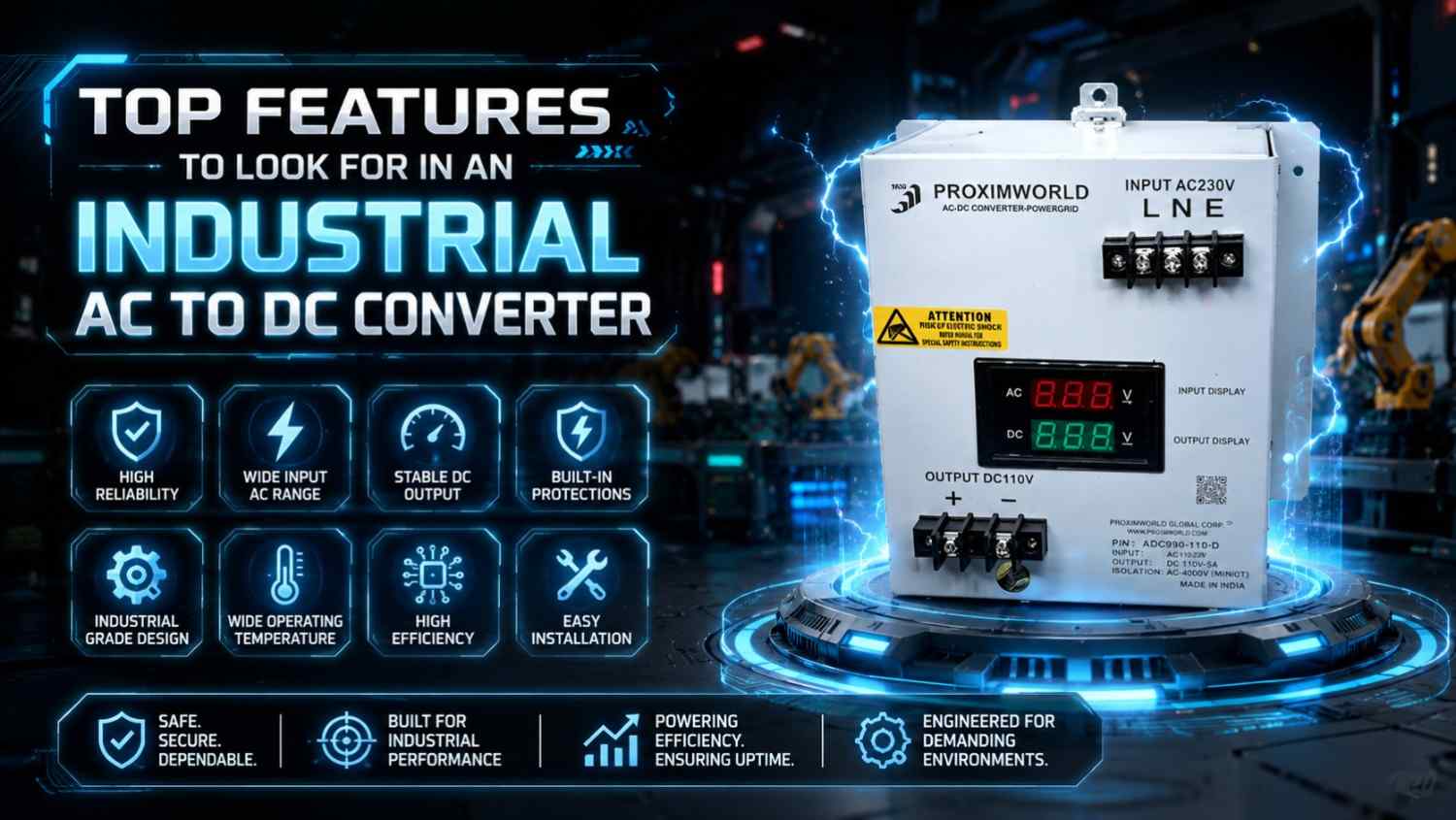
Whether you’re designing a control panel, powering industrial machinery, or building a ruggedized embedded system, choosing the right AC to DC converter can make or break your project. Unlike consumer-grade adapters, industrial power electronics must handle harsh environments, fluctuating loads, and non-negotiable reliability demands. The market offers dozens of options — but not all are built equal.
At ProximWorld, we specialize in sourcing and supplying power electronics components trusted by engineers worldwide. In this guide, we break down the top features you should evaluate before purchasing an industrial AC to DC converter — covering everything from voltage conversion specs to thermal protection and beyond.
Standard desktop power supplies are optimized for stable indoor environments and predictable loads. Industrial power electronics operate under entirely different rules: wide input voltage ranges, exposure to vibration, dust, moisture, extreme temperatures, and the constant expectation of continuous operation with zero downtime.
A quality industrial DC power supply must deliver consistent, clean output voltage even when the input AC line fluctuates — a scenario common in factories, substations, and remote installations. This is why understanding the feature set of a converter is not optional — it is essential engineering due diligence.
Key Insight: Industrial converters must often pass certifications like CE, UL, and IEC 61010-1 before they can be used in regulated environments such as medical, oil & gas, or defense applications.
The first specification to examine is the input voltage range. Industrial facilities often experience voltage sags, surges, and phase imbalances. A converter with a wide universal input — typically 85 VAC to 264 VAC — ensures stable voltage conversion across varying grid conditions without requiring manual range switching.
Look for converters that also support three-phase input if your application demands higher power density, as this is common in heavy manufacturing environments.
Efficiency is not just an environmental consideration — it directly impacts your operating costs and thermal management requirements. Industrial-grade converters typically achieve 90–95% efficiency. Lower efficiency means more heat generation, which in turn means more aggressive (and expensive) cooling solutions.
When comparing models, check the efficiency curve at partial loads (e.g., 20%, 50%, 100% load), because many converters are optimized only at full load while being inefficient under lighter conditions — a common scenario in real-world deployments.
A reliable industrial DC power supply must include comprehensive protection features. These safeguard both the converter itself and the downstream equipment:
Always verify these protections are auto-recovery (hiccup mode) or latch-off, depending on your system’s restart requirements.
Industrial environments are rarely temperature-controlled. From foundries operating at 60°C+ to outdoor substation enclosures in sub-zero winters, power electronics must perform without derating or failure across a wide thermal window.
Look for converters rated for −40°C to +85°C operation. Pay close attention to the derating curve — some units drop to 50% output capacity above 40°C. Also check whether the unit uses convection cooling, forced air, or is conformal-coated for humid environments.
Sensitive industrial electronics — PLCs, sensors, communication modules — are susceptible to ripple noise on the DC rail. A well-designed converter should have output ripple below 50mV peak-to-peak and comply with EMI standards such as EN 55032 Class B.
This feature is especially critical in precision measurement equipment and high-speed data acquisition systems, where clean power directly correlates with data accuracy.
Not all load requirements are fixed. A good industrial converter offers output voltage trim (typically ±10–20%) to fine-tune the DC output without additional regulators. Remote sense terminals allow the converter to compensate for voltage drop in long cable runs — ensuring the load always receives the correct voltage.
Some advanced models also feature remote on/off control and parallel operation capability, enabling modular power architectures ideal for redundant systems in critical infrastructure.
Understanding where these power electronics are deployed helps engineers identify the right product class. Here are the most prevalent use cases across industrial sectors:
Programmable logic controllers and industrial automation systems rely on stable 24 VDC rails derived from AC mains through high-quality converters.
High-density server racks and telecom base stations require rack-mount AC to DC converters with hot-swap capability and N+1 redundancy.
Solar inverters and wind turbine control systems use ruggedized converters for both primary power and auxiliary circuits in outdoor enclosures.
Patient-connected devices demand leakage current below 100µA. Medical-grade converters meet IEC 60601 for safe, isolated DC power supply in clinical settings.
Modern industrial converters predominantly use switched-mode power supply (SMPS) topology rather than older linear designs. The process involves four stages:
This SMPS architecture is what enables modern DC-DC converters and AC-DC units to achieve such high efficiency in a compact form factor — something impossible with older transformer-based linear supplies. Understanding this topology also helps engineers troubleshoot noise issues, since each stage introduces its own EMI signature.
The isolation barrier — achieved through the high-frequency transformer — is what qualifies converters as “isolated,” which is a safety-critical requirement in medical and hazardous location applications. For non-isolated designs, DC-DC converters using buck or boost topology provide efficient voltage conversion without galvanic separation.
To understand the investment required for industrial-grade power electronics, here is a side-by-side comparison of what separates industrial converters from their commercial or consumer counterparts.
| Feature | Commercial Grade | Industrial Grade |
|---|---|---|
| Input Voltage Range | 100–240 VAC (manual) | 85–264 VAC (auto) |
| Operating Temperature | 0°C to 40°C | −40°C to +85°C |
| MTBF (Mean Time Between Failures) | ~100,000 hrs | > 500,000 hrs |
| Protection Features | OVP only | OVP + OCP + OTP + SCP |
| Certifications | CE basic | CE, UL, IEC 61010, ATEX |
| Output Ripple | ~150mV p-p | < 50mV p-p |
| Parallel / Redundancy | Not supported | Supported (N+1) |
Active Power Factor Correction (PFC) is increasingly required by international standards like IEC 61000-3-2. A converter with built-in PFC draws current in phase with the supply voltage, reducing harmonic distortion and improving overall grid efficiency.
In large industrial installations, poor power factor can result in utility penalties and reduced apparent power capacity on your distribution panels. Always specify a power factor of >0.95 for new industrial designs.
Selecting the right industrial AC to DC converter is not about picking the cheapest option or the most recognizable brand. It requires a careful evaluation of input range, efficiency, protection circuits, thermal performance, certifications, and output quality — all matched to your specific application environment.
Whether you’re engineering a new control panel or upgrading existing industrial electronics, the specifications outlined in this guide provide a reliable checklist to benchmark any converter against. Features like active PFC, wide-temperature operation, and comprehensive protection are not luxuries — they are the baseline expectation for serious industrial deployments.
For sourcing verified, specification-matched power electronics components, explore the curated range of AC to DC converters at ProximWorld — where every listing includes full technical documentation to support your engineering decisions.

Leave a comment