
No products in the cart.

Introduction
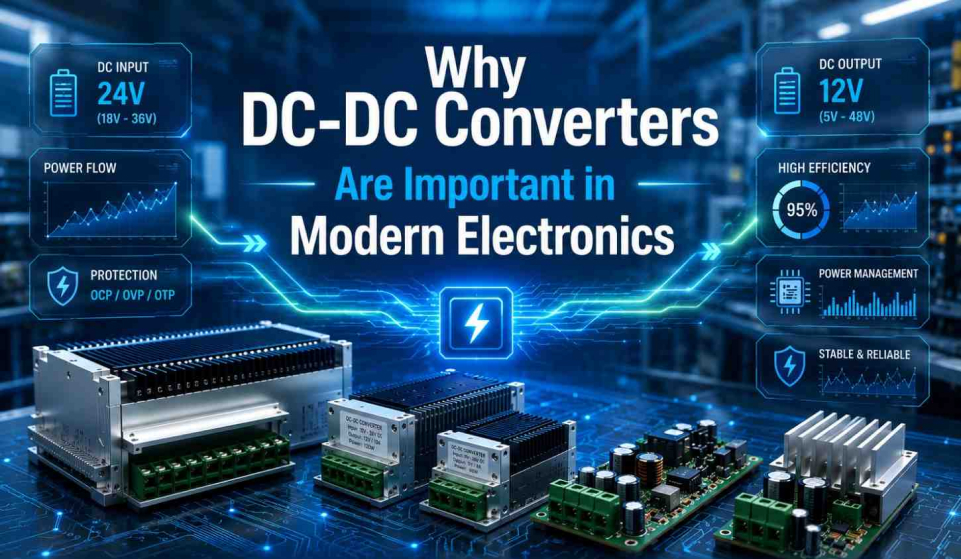
In an era where virtually every piece of technology runs on carefully regulated electrical power, DC-DC converters have quietly become one of the most indispensable components in power electronics. From the smartphone in your pocket to massive industrial machinery on factory floors, these compact devices perform the critical job of transforming one DC voltage level into another — efficiently, reliably, and continuously.
Yet despite their ubiquity, DC-DC converters often go unnoticed by the end user. Understanding why they matter — and where they are used — can help engineers, procurement specialists, and technology enthusiasts make better decisions when designing or sourcing power solutions. At ProximWorld, we specialize in providing high-quality power electronics components to industries that depend on precision and reliability.
This article explores why DC-DC converters are so critical in modern electronics, how they work, where they are applied, and what to look for when selecting one for your application.
What Is a DC-DC Converter?
A DC-DC converter is an electronic circuit that converts a source of direct current (DC) from one voltage level to another. Unlike AC-DC power supplies that convert alternating current from the mains grid, DC-DC converters operate entirely within DC systems — making them essential for battery-powered devices, automotive electronics, renewable energy systems, and industrial control equipment.
The three fundamental types are:
Buck Converter
Steps down voltage (e.g., 24 V → 5 V). Used in microcontroller circuits, USB charging, and LED drivers.
Boost Converter
Steps up voltage (e.g., 3.7 V → 12 V). Common in battery-operated devices and automotive applications.
Buck-Boost Converter
Handles both step-up and step-down with polarity inversion. Ideal for variable-input systems such as solar panels.
Beyond these basics, there are also isolated topologies such as flyback, forward, and full-bridge converters — used when electrical isolation between input and output is required for safety or noise reduction in sensitive power electronics designs.
Key Benefits of DC-DC Converters in Modern Electronics
The widespread adoption of DC-DC converters across industries is no accident. They offer a combination of performance, flexibility, and efficiency that no other power conversion technology can match at the component level.
Where DC-DC Converters Are Used: Real-World Applications
The reach of DC-DC converter technology is extraordinary. If a device runs on batteries or a regulated DC rail, there is almost certainly a converter involved. Here are the most significant application areas:
🚘
Automotive Electronics
Modern vehicles use dozens of DC-DC converters to power infotainment systems, ADAS sensors, LED lighting, and electric powertrain controls. EV battery management systems rely on isolated converters to safely interface high-voltage packs with low-voltage logic circuits.
💻
Data Centers & Telecommunications
Server racks require tightly regulated voltages for CPUs, memory, and storage. Point-of-load (POL) DC-DC converters are placed directly near the load to minimize distribution losses and ensure voltage accuracy within tight tolerances.
☀
Renewable Energy Systems
Solar panels and wind turbines generate DC power at variable voltages. Maximum Power Point Tracking (MPPT) converters — a specialized form of DC-DC conversion — continuously adjust the operating point to harvest the maximum available energy.
⚙
Industrial Electronics & Automation
In industrial electronics, PLCs, sensors, motor drives, and SCADA systems all require stable DC power supply rails. DC-DC converters provide isolation from noisy bus voltages and protect sensitive instrumentation from industrial transients. Explore our full range of DC-to-DC converters for industrial use.
⚕
Medical & Defense Electronics
Medical imaging equipment, patient monitors, and portable diagnostic tools rely on isolated DC-DC converters to ensure electrical safety between patient contact points and internal electronics. Military and aerospace applications demand rugged converters rated for extreme temperatures and shock resistance.
How DC-DC Converters Work: A Technical Overview
Understanding the operating principle behind DC-DC converters helps engineers select the right topology for their application. Most modern converters use switch-mode technology based on three core phases:
1. Switching
A semiconductor switch (typically a MOSFET) rapidly turns on and off at frequencies ranging from tens of kilohertz to several megahertz. This converts continuous DC into a pulsed waveform, enabling energy storage and transformation.
2. Energy Storage & Transfer
An inductor stores energy during the ON phase and releases it during the OFF phase. The ratio of ON-time to the total period (duty cycle) determines the output voltage level — a fundamental principle of voltage conversion in switching regulators.
3. Filtering & Regulation
Output capacitors smooth the pulsed waveform into clean DC. A feedback control loop continuously monitors the output voltage and adjusts the duty cycle to maintain regulation — even as input voltage or load current changes.
DC-DC Converter vs Linear Regulator: Which Should You Choose?
Engineers often face the choice between a switching DC-DC converter and a simple linear regulator. The following comparison highlights the trade-offs:
| Feature | DC-DC Switching Converter | Linear Regulator |
|---|---|---|
| Efficiency | 85–98% | Vout/Vin (often <50%) |
| Heat Dissipation | Very low | High (dissipates as heat) |
| Voltage Conversion | Step-up, step-down, isolated | Step-down only |
| Output Noise | Moderate (switching ripple) | Very low (ideal for RF/audio) |
| Design Complexity | Moderate (requires L and C) | Simple (minimal components) |
| Cost | Moderate to high | Low |
| Best For | High-power, battery, industrial | Low-power, noise-sensitive |
In most high-power and battery-operated designs, the efficiency advantage of switching DC-DC converters far outweighs their added complexity.
Conclusion: The Invisible Backbone of Modern Power Electronics
DC-DC converters are among the most enabling technologies in contemporary electronics engineering. Their ability to efficiently transform voltage levels makes it possible to run sophisticated, multi-rail electronics from a single battery or bus voltage — unlocking the performance of everything from consumer gadgets to heavy industrial electronics.
As electronics continue to evolve toward higher power densities, greater energy efficiency, and miniaturization, the role of DC-DC converters will only expand. Understanding their types, operating principles, and trade-offs is no longer optional for engineers — it is a core competency in modern power electronics design.
Whether you are designing a next-generation EV system, upgrading industrial control infrastructure, or building a compact IoT node, sourcing reliable, high-quality converters is critical to your project’s success. Browse the curated selection at ProximWorld to find the right DC power supply and conversion solution for your application.

Leave a comment