
No products in the cart.

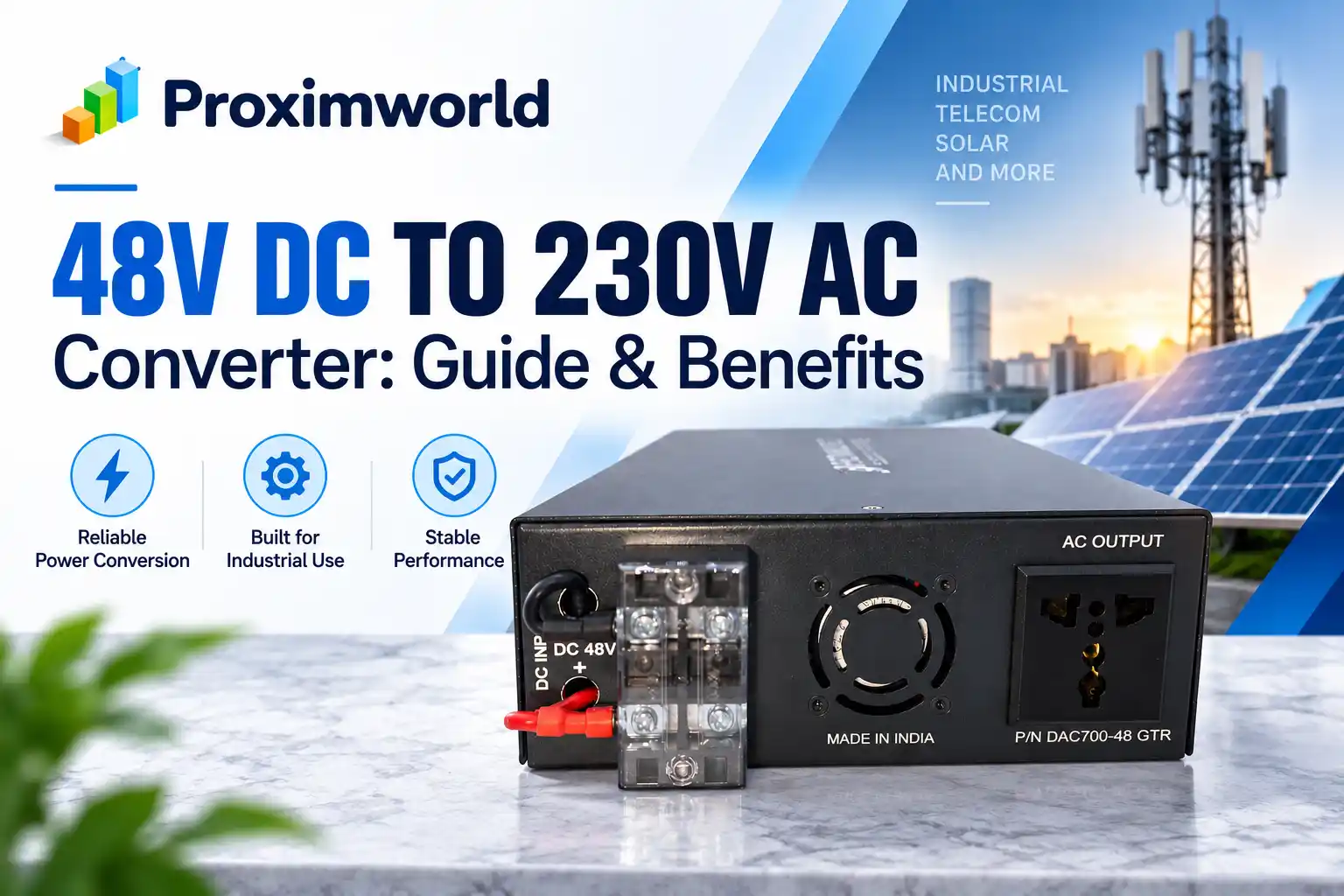
In industrial automation, telecom towers, and data centers, battery banks and solar generators standardize at 48V DC to cut cable losses. As a result, a 48V DC to 230V AC converter (pure sine wave inverter) bridges these battery banks to standard 230V single-phase machinery, control panels, and servers with zero downtime.
Most mission-critical backup power sources — battery banks, solar arrays, and telecom rectifier systems — store and deliver energy as Direct Current (DC). However, the vast majority of industrial equipment, control panels, cooling fans, and networking hardware are engineered to run on Alternating Current (AC). Therefore, a DC to AC converter is essential to bridge that divide.
In particular, 48V DC is the global safety threshold for Extra-Low Voltage (SELV) and the established standard for telecom battery banks, railway auxiliary power, and commercial solar energy storage. Consequently, it delivers higher power without hazardous high voltages.
In addition, single-phase 230V AC at 50Hz matches utility grid power standards across Europe, Asia, and international industrial environments. Because of this, off-the-shelf control gear and servers run directly from battery reserves.
Furthermore, if you are looking for a broader introduction to inverter technology first, our DC to AC Converter: Working, Uses & Buying Guide covers foundational inverter physics in detail.
A DC to AC converter — also known as an industrial power inverter — is an active electronic system that converts unidirectional Direct Current (DC) into bidirectional, sinusoidal Alternating Current (AC). Specifically, while batteries only store flat DC energy, utility-grade equipment such as electric motors, automation relays, cooling fans, and servers strictly require alternating current.
In contrast to consumer inverters built for intermittent recreational usage, an industrial DC to AC converter is engineered for continuous 24/7/365 heavy-duty operation. For this reason, key industrial design requirements include:
Transforming a low-voltage 48V DC input into a pristine 230V AC sine wave requires high-speed solid-state switching, high-frequency filtering, and magnetic voltage step-up. Ultimately, the process occurs in three coordinated stages:
First, the steady 48V DC battery input is rapidly toggled on and off by power MOSFET or IGBT transistors at ultrasonic frequencies. As a result, this creates a pulse-width modulated (PWM) pulse stream.
Next, inductor-capacitor (LC) low-pass filtering strips away high-frequency switching harmonics. Consequently, the pulsed signal is smoothed into a pure, distortion-free 50Hz sinusoidal alternating wave.
Finally, an internal transformer steps the voltage up from 48V to 230V AC. At the same time, it establishes critical galvanic isolation so that sensitive loads remain shielded against DC ground faults and surges.
Overall, specifying an industrial 48V input converter brings key operational benefits over low-voltage 12V/24V alternatives:
Zero-Interruption Continuity
The system draws directly from the 48V battery bank. Therefore, critical 230V machinery continues running seamlessly through grid blackouts without waiting for diesel generators to spin up.
Grid-Quality Pure Sine Wave
An ultra-low Total Harmonic Distortion (THD < 3%) ensures clean power. As a result, electric motors, PLCs, and telemetry operate quietly and coolly without electromagnetic buzzing or stress.
Direct Telecom & Solar Synergy
The unit integrates natively into standard 48V battery plants and solar MPPT arrays. Consequently, operators avoid purchasing intermediate voltage conversion hardware or inefficient DC step-up modules.
True Galvanic Isolation
In addition, transformer-isolated design prevents ground fault loops between DC battery banks and AC neutral conductors. This protects expensive networking and sensor racks against destructive ground currents.
48V to 230V converters are deployed across diverse sectors where 48V battery reserves must power 230V AC machinery. Specifically, here are the core industrial use cases:
Before shortlisting a converter, therefore, cross-reference your site specifications against this technical evaluation checklist:
| Specification Parameter | Engineering Significance |
|---|---|
| DC Input Range | Must tolerate 40V to 60V DC because battery banks fluctuate between deep discharge and bulk charging float voltages. |
| AC Output & Frequency | Regulated 230V AC ±2% at 50Hz (or 60Hz) is maintained so that regional grid machinery operates without voltage sags. |
| Output Waveform Quality | Pure Sine Wave (THD < 3%) is mandatory, since sensitive PLCs, servers, and sensors require distortion-free power. |
| Continuous Capacity | Must supply continuous operating watts as well as minimum 2x surge headroom for inductive motor startup. |
| Conversion Efficiency | High efficiency (≥90%) cuts heat generation. Consequently, it significantly extends emergency battery runtime. |
| Hardware Protections | In addition, overload, short circuit, reverse polarity, over-temperature, and DC voltage cutoffs prevent equipment damage. |
| Mounting Configurations | Finally, chassis mount, DIN-rail, or standard 19-inch rackmount designs adapt easily to any cabinet architecture. |
Comparing 48V pure sine wave converters against lower voltage and modified sine wave alternatives highlights why 48V is the preferred enterprise choice. In particular, the operational differences are summarized below:
| Comparison Metric | 48V Pure Sine Wave Inverters | 12V / 24V Input Converters | Modified Sine Wave Units |
|---|---|---|---|
| Primary Applications | Telecom, Data Centers, Rail, Microgrids | Vehicles, RVs, Light solar backup | Resistive heaters, simple halogen lamps |
| Maximum Power Band | High (Up to 10kW+ without thick cables) | Limited by cable gauge & high amperage | Low to medium wattage |
| Waveform Integrity | Clean Utility Sine (THD < 3%) | Model dependent (Pure or Modified) | Choppy stepped square wave |
| Sensitive Load Safety | 100% Safe for Motors, PLCs & Servers | Safe only if Pure Sine Wave model | High risk of motor burnout & buzzing |
| Cable Copper Savings | Max Savings (75% less copper than 12V) | Requires heavy, expensive copper wire | Variable |
To ensure reliable performance, follow this 7-step engineering checklist to specify the ideal unit without overspending or risking downtime:
1.
2.
3.
4.
5.
6.
7.
Specifically, Proximworld’s 48V DC to 230V AC Converter is engineered for mission-critical conversion from 48V DC battery banks to single-phase 230V AC at 50Hz. Because it utilizes heavy-duty components and built-in galvanic isolation, it provides dependable power in harsh environments.
In addition, our electrical engineering team can review your continuous wattage, surge requirements, and cabinet mounting format for custom sizing and quote assistance.

Leave a comment